Latest update: 27 August 2026 - 15 min read
What Is a Vehicle Allowance? A Guide for Healthcare and Care Sector Employers
A vehicle allowance is a per-kilometre payment you make to an employee who’s required and authorised to use their own car for work. The per-km rate for healthcare and care staff is set by different awards that cover each employee, not by company policy. It’s different from a fixed monthly car allowance, which is a lump-sum payment that some employers offer instead of a company vehicle.
Disability support workers, home care staff, community nurses, allied health professionals and personal carers often work side by side on the same roster, but they’re not all covered by the same award. Each award sets its own vehicle allowance rate, its own rules about what counts as paid travel, and has its own quirks that catch employers out.
Making sure you know under which award each of your staff is helps you allocate the right driving allowance. It also keeps you compliant and prepared in case of a Fair Work audit, a resignation-triggered back-pay claim, or a workers’ compensation claim after an incident on the road.
The four awards at a glance
Most multi-disciplinary providers have staff sitting across some combination of four awards. Here’s how vehicle allowance obligations compare across them, based on rates effective from 1 July 2026 — with a temporary change layered on top from 1 September 2026 (see below the table).
| Award | Typical roles covered | Vehicle allowance rate | What’s compensable |
|---|---|---|---|
| Social, Community, Home Care and Disability Services Industry Award (SCHADS) | Disability support workers, home care workers, case managers, community services staff | $1.05/km (1 Sept 2026–28 Feb 2027 only; $1.01/km outside that window) | Travel required by the employer, including transporting a client or their belongings, and travel between clients during a shift |
| Aged Care Award | Personal care workers, assistants in nursing, general and food services staff in aged care | Not less than $1.05/km (1 Sept 2026–28 Feb 2027 only; $1.01/km outside that window) | Travel required and authorised by the employer in the course of duties |
| Nurses Award | Registered and enrolled nurses (including in aged care), nurse practitioners | Not less than $1.01/km, with an exclusion for senior classifications (see below) | Travel required and authorised by the employer |
| Health Professionals and Support Services Award | Allied health professionals (physiotherapists, occupational therapists, speech pathologists), health support workers | Not less than $1.01/km | Travel required and authorised by the employer |
The four awards were aligned at $1.01/km from 2022, when the Fair Work Commission standardised them, until a temporary FWC decision split them again. From 1 September 2026 to 28 February 2027, a Fair Work Commission Full Bench decision (case AM2026/10, [2026] FWCFB 224) lifts SCHADS and Aged Care Award vehicle allowances to $1.05/km. The Nurses Award and the Health Professionals and Support Services Award stay at $1.01/km for the same period. Outside that window, all four awards revert to moving together with the Fair Work Commission’s Annual Wage Review — so re-check the rate after 28 February 2027, when the temporary increase is due to lapse.
It’s tempting to treat the vehicle allowance as one uniform rule you can set once and forget, especially since the four awards are so close in rate. That’s a mistake. Each award applies to a different, non-overlapping set of roles. Getting the award wrong for one employee is a coverage error, not a rounding error — and while the SCHADS/Aged Care increase is in effect, it’s also the difference between paying $1.01 and $1.05 per kilometre.
Each award’s rate is a floor, not a fixed number. It applies once you’ve confirmed which award each of your staff sits on. That’s a bigger job than it sounds for a mixed team, and now that SCHADS and Aged Care no longer match Nurses and HPSS, confirming the award matters more than it used to.
The “what’s compensable” column is where the real differences show up. SCHADS explicitly names transporting a client or their belongings as compensable travel. The other three awards define it more broadly, as travel required and authorised by the employer. The Nurses Award also carves senior classifications out of the clause entirely (more on that below).
Treat the table as a starting checklist for every role on your roster, not a single number to apply organisation-wide. Use Fair Work’s Pay and Conditions Tool to confirm both the award per employee and the current rate before you commit to a figure in a contract or policy — and check it again once the temporary SCHADS/Aged Care increase lapses on 28 February 2027.
What is the ATO cents-per-km rate vs. the award rate?
These are two different figures for two different purposes, and confusing them is one of the more common vehicle allowance mistakes employers make.
The award rate — $1.05/km for SCHADS and Aged Care Award staff until 28 February 2027, $1.01/km for Nurses Award and Health Professionals and Support Services Award staff — is the minimum you’re required to pay a staff member as a vehicle allowance under their modern award. It’s an industrial relations obligation set by the Fair Work Commission, and it’s what should appear in the employee’s contract and on their payslip.
The ATO cents-per-kilometre rate is a separate figure set by the Australian Taxation Office for individuals to calculate a tax deduction for work-related car expenses on their own tax return. It’s $0.91/km for the 2026-27 tax year, and it’s capped at 5,000 business kilometres per year.
The two rates aren’t linked, and you’re not required to pay the ATO rate as an employer. For more on how the ATO method works and how it interacts with what you pay as an employer, see our guide to mileage reimbursement for employers.
What counts as paid travel vs. commuting?
The vehicle allowance question that trips up most employers isn’t the rate; it’s what travel actually qualifies for the per km vehicle allowance. Across all four awards, the same basic rule applies: an employee’s ordinary commute from home to their first work location and back home at the end of the day isn’t covered by a vehicle allowance. Travel that happens once they’re already on duty, such as between clients, between sites, or on a work errand, is paid with the per-kilometre allowance.
Award-specific quirks employers miss
Beyond the headline rate, each award carries at least one detail that a provider running mixed teams may miss.
The Nurses Award RN Level 4–5 exclusion
Under the Nurses Award, most of the award’s allowances, including the vehicle allowance, don’t apply to employees classified as a Registered Nurse Level 4 or Level 5. These are typically senior nursing roles: nurse managers, clinical nurse consultants, and directors of nursing. The reasoning is that these classifications are remunerated at a level that already covers the incidental costs an allowance would cover.
If your organisation has senior nurses who occasionally use their own car for work, such as to attend a multi-site clinical meeting or visit a facility, don’t assume the same vehicle allowance clause that covers your Level 1–3 nurses applies to them. Check their classification against the award before you set up their pay, and don’t rely on a payroll template built around your more junior nursing roles.
Why are most aged care nurses covered by the Nurses Award, not the Aged Care Award?
It’s a common assumption that anyone working in aged care is covered by the Aged Care Award. In practice, registered and enrolled nurses in aged care are covered by the Nurses Award, not the Aged Care Award, and they’re paid under a specific aged care pay structure within that award that’s been the subject of recent Fair Work Commission work value decisions. The Aged Care Award itself covers personal care workers, assistants in nursing (in some settings), and general and food services staff. Since 1 January 2025, nursing assistants providing care to older people have also moved off the Nurses Award and onto the Aged Care Award or the SCHADS Award, depending on the setting.
As a residential aged care provider, this means your registered nurses, your personal care workers, and your nursing assistants can each sit under a different award, each with its own vehicle allowance clause and its own rate.
This is exactly the kind of mixed-award structure that’s easy to miss until a pay dispute, a new hire’s contract, or a Fair Work audit forces the question. If you’ve been applying one vehicle allowance rate across your whole aged care team on the assumption that “aged care” means “Aged Care Award,” it’s worth checking every classification against the award that actually applies.
SCHADS minimum engagement and broken shifts
The SCHADS Award has two features that specifically affect community and home care staff who drive between clients. First, each working period within a broken shift has a minimum engagement, generally two hours, so a client visit that only needs 45 minutes still has to be paid as a two-hour engagement. Second, a broken shift allowance (clause 25.6) applies to any unpaid, non-meal-break gap between working periods, regardless of how long that gap is.
Where this intersects with the vehicle allowance is the travel itself.
- Travel between clients within a continuous shift is paid time, and the employee should receive a per-km vehicle allowance for the kilometres travelled.
- Travel during an unpaid break in the middle of a broken shift, when the employee is free from work duties, generally isn’t paid and doesn’t qualify for the allowance.
This is a distinction you must apply consistently: two employees can have visually identical rosters, one with an unpaid broken-shift gap and one with paid travel time between back-to-back clients, and only the underlying shift structure tells you which rule applies. If your rostering treats every gap between client visits the same way, you may be under- or overpaying depending on whether that gap is a genuine unpaid break or paid travel time within a shift.
Work Health and Safety and your duty of care
The per-km vehicle allowance is a Fair Work obligation, but it sits alongside another: work health and safety law. Paying the correct rate doesn’t remove your responsibility for what happens once your health and care employees are on the road. Most states and territories have adopted a version of the model Work Health and Safety Act 2011. Victoria hasn’t — it operates under the Occupational Health and Safety Act 2004 (Vic) instead, so check the Victorian Act if that’s where your staff are based.
Why does a personal vehicle count as a workplace?
When a staff member drives their own car for work purposes, whether to visit a client, move between sites, or run a work errand, that car is considered a workplace under work health and safety law (the Work Health and Safety Act in most states and territories, or the Occupational Health and Safety Act 2004 in Victoria), meaning you have a duty of care for your employees while they drive.
Safe Work Australia has a dedicated chapter on vehicle hazards for the health care and social assistance industry specifically, because vehicle-related incidents are consistently high in Australia, and health, community and care work involves more driving between locations than many other sectors.
There is no minimum distance threshold
There’s no minimum distance before your duty of care applies. A five-minute drive between two clients carries the same legal duty of care as a longer trip between sites. That means a policy that only considers safety for long drives, interstate travel, or trips over a certain number of kilometres misses most of the actual risk your staff face day-to-day.
The practical takeaway is this: if your vehicle allowance policy stops at the payroll line, it’s incomplete. You need to treat staff vehicles as workplaces and ensure their safety. See how to do so in our dedicated guide on WHS for health and care staff.
Why personal vehicles, or grey fleets, are the sector norm
Staff using their personal vehicles for work, instead of vehicles owned or leased by the business, is known as a grey fleet and is the norm across disability, aged care, allied health, and community nursing. The work itself is multi-site, rostering changes week to week, clients are spread across a wide area, and staff often move between several employers or services on the same day, which makes a traditional fleet impractical for most providers in this sector.
When you manage a grey fleet, you need to make sure the basics are covered: staff are on the right award and rate, you have a strong Work Health and Safety policy, business kilometres are tracked consistently, and you carry out risk assessments for each vehicle and each staff member. Our guide to grey fleets in Australia will walk you through what that looks like in practice, including a grey fleet risk assessment and a policy template you can adapt to a mixed-award care team.
Recording vehicle expenses
Whichever award applies, you need records that would hold up if Fair Work or the ATO asked for them. In practice, that means:
- A trip-by-trip log of the business kilometres driven under the vehicle allowance, captured as they happen rather than reconstructed later. Both Fair Work and the ATO treat contemporaneous records as far stronger evidence than an estimate written up after the fact.
- Each entry should show the date, distance, and purpose of the trip, and, ideally, the client or site visited.
- Your records should also clearly separate paid business travel from ordinary commuting, since only the former is compensable, and your payroll records need to show the allowance was paid at the correct award rate for each employee’s classification.
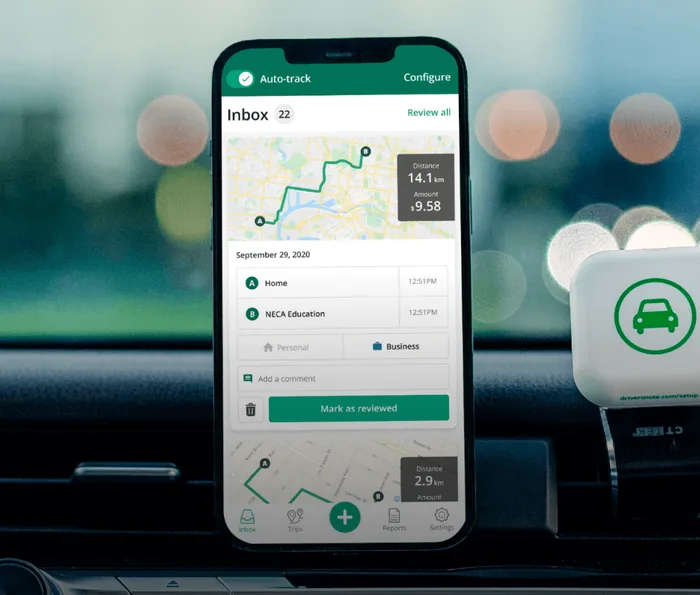
For staff who see multiple clients a day across broken or split shifts, a logbook app that timestamps trips as they’re driven is generally more reliable than manual timesheets or end-of-week estimates. Our guide to ATO car logbook requirements covers what a compliant record needs to include.
What to check first in your own organisation
Before anything else, note the awards down against each role, not each department, since two people with similar job titles can sit on different awards depending on their duties and classification.
From there, check three things:
- Whether each employee is classified correctly, particularly senior nurses, who may be excluded from the vehicle allowance clause entirely, and aged care nurses, who are often assumed to sit on the wrong award.
- Whether travel between clients is being paid and reimbursed correctly, accounting for genuine unpaid breaks and ordinary commuting, especially when your rosters include broken shifts.
- Whether your reimbursement records would hold up under an ATO or Fair Work review if someone asked for them tomorrow.
Also read: How to find the best ATO compliant car logbook app
Tired of logging mileage by hand?
Effortless. IRS-compliant. Liberating.
 Auto-track trips
 Classify trips
 IRS compliant reports