Latest update: 23 April 2026 - 10 min read
Grey Fleet Policy: Template and Practical Guide
If employees use their own cars for work, it’s recommended to have a grey fleet policy. It helps your business set expectations for employees, vehicle requirements, journey records, and employer responsibilities in one clear process.
This guide covers how Australian businesses can create a practical grey fleet policy that supports compliance and day-to-day admin.
Is a grey fleet policy legally required in Australia?
There is no single Australian law that requires a document called a “grey fleet policy.” But under the Work Health and Safety (WHS) Act 2011, employers must take reasonably practicable steps to manage work-related risks — and driving in personal vehicles for work sits inside that obligation.
A written policy is the clearest way to show those steps are being taken. It documents what you expect of drivers, what checks you run, and how work-related driving is reimbursed and recorded. That’s what makes it useful in an audit, an insurance dispute, or an incident investigation.
Legal and compliance perspective
When an employee drives for work, that activity falls within your work health and safety obligations. Employers are required to take reasonably practicable steps to manage health and safety risks arising from work, including driving in employee-owned vehicles.
That doesn’t mean you control every aspect of a private vehicle. It does mean a grey fleet shouldn’t sit as an informal arrangement with no checks or documentation.
A policy usually helps you show you have a process to:
- Verify licences and driving eligibility
- Check vehicles are suitable for the work involved
- Require current registration and appropriate insurance
- Communicate safe driving expectations
- Keep records of approvals, declarations, and business kilometres
A policy doesn’t remove risk — it shows risk is being managed in a structured way.
Why a policy matters
A grey fleet risk is often underestimated because the business doesn’t own the vehicles. But the exposure doesn’t disappear. The main risk areas are straightforward:
- A driver isn’t properly licensed
- A vehicle isn’t maintained or fit for purpose
- Insurance doesn’t reflect business use
- Long or higher-risk trips happen with little oversight
- Records are too weak to support reimbursement, audit, or compliance review
A policy helps you address those issues before an incident, not after one.
What should an Australian grey fleet policy include?
A practical policy covers the same core risk areas.
1. Driver eligibility
Set minimum requirements for anyone using a personal vehicle for work:
- A valid and appropriate driver licence for the vehicle class
- A requirement to notify the business of suspensions, restrictions, or relevant offences
- Confirmation the driver is fit to drive and able to complete work travel safely
2. Vehicle suitability and safety
Define what kinds of vehicles are acceptable for work use:
- Roadworthy, registered vehicles
- Minimum safety expectations relevant to the role (for example, working seatbelts, airbags, warning systems; some employers add an ANCAP safety rating minimum for long-distance or high-frequency drivers)
- Restrictions for unsuitable, modified, or high-risk vehicle types where needed
The standard should be “fit for purpose,” not just “technically registered.”
3. Maintenance and roadworthiness
Require employees to keep their vehicles in a safe condition:
- Servicing in line with manufacturer guidance
- Responsibility for basic safety checks (tyres, brakes, lights, fluids)
- A process for reporting and acting on defects or unsafe vehicles
4. Insurance and registration
This is one of the most important areas of a grey fleet policy. The key fact: a standard private-use Comprehensive policy in Australia usually does not automatically cover work-related driving.
Employees need to either confirm with their insurer that business use is included, or add it to the policy (commonly as a “Class 1 Business Use” endorsement, though exact names vary by insurer). Without that confirmation, a claim arising from a work trip can be reduced or refused.
Your policy should require employees to, before any work-related driving:
- Hold current vehicle registration
- Hold insurance that explicitly covers business use (not just private/pleasure)
- Provide written confirmation (a screenshot or Certificate of Currency from their insurer) that their policy covers work-related driving
Where an employee’s existing policy doesn’t cover business use, the policy should make clear that they can’t be reimbursed for work kilometres until cover is updated. That turns a vague expectation into an actionable, enforceable rule.
5. Journey management
A good policy doesn’t assume every trip needs to happen by car. Include guidance on:
- Whether the trip is actually necessary
- Whether a remote meeting, public transport, or another option is more appropriate
- Planning for distance, fatigue, time of day, and road conditions
6. Incident reporting and records
Make it clear what must be reported and what records must be kept:
- Crashes, near misses, and vehicle defects
- Licence, registration, and insurance check outcomes
- Records for every work journey
- Signed declarations (for example: a driver’s acknowledgement of the policy at onboarding, annual insurance confirmation, incident reports within 24 hours of an event, and manager approvals for trips over a set distance or duration)
Business journeys, reimbursement, and ATO considerations
This area trips up many businesses because it conflates two related but distinct concepts. Spelling them out in the policy keeps finance, payroll, and drivers aligned.
The ATO cents-per-kilometre rate
For the 2026–27 income year, the ATO cents-per-kilometre rate is 91 cents per km for eligible car expense claims under the cents-per-kilometre method. It’s capped at 5,000 business km per car per income year (only applicable to tax deductions).
Important: this is a tax deduction method that individuals (sole traders, partnerships, and employees) use on their own tax return. It is not a reimbursement rate that employers are required to pay. Employers can choose to reimburse at the ATO rate, above it, or below it.
What the policy should say about reimbursement
For employers, the policy question is: how will business travel be recorded and reimbursed internally?
A practical policy requires a trip record for each work journey, capturing:
- Date
- Business purpose
- Start and end location
- Distance travelled
With proper per-kilometre records tied to actual business travel, reimbursements paid at or below the ATO rate are generally treated as a reimbursement of expenses — not as taxable income to the employee — and are generally FBT-exempt because they cover business use of the employee’s private vehicle.
In short, good records make the reimbursement clean. Weak records push the tax treatment in the wrong direction for everyone involved.
FBT treatment can vary depending on the arrangement (especially where car allowances, novated leases, or mixed-use is involved). If the business wants certainty, confirm the approach with an accountant or payroll specialist — and document the chosen method in the policy so it’s applied consistently.
How to implement a grey fleet policy without adding admin
A policy only works when it fits daily operations, not when it sits in a folder nobody opens.
Make the rules easy to find: Add the policy to onboarding, travel approval workflows, and internal guidance so it’s visible from day one.
Make compliance easy: Use simple submission rules and standard approval steps. When people know exactly what to do, the chances they’ll do it are higher.
Build checks into the process: Set reminders for expiring documents, require current records before reimbursement, and standardise journey logging across the team.
Consistent kilometre tracking is often the single highest-leverage change — it cleans up reimbursement data, strengthens audit trails, and gives managers visibility into how much work-related driving is actually happening.
Review it regularly: Review the policy at least annually, or sooner if travel patterns, payroll processes, or compliance needs change.
Grey fleet policy checklist
Use this as a quick sense-check before publishing or rolling out your policy.
| Area | Included in policy? |
| Driver licence verification | Yes / No |
| Vehicle suitability requirements | Yes / No |
| Maintenance and roadworthiness expectations | Yes / No |
| Registration check process | Yes / No |
| Business-use insurance requirement and written confirmation | Yes / No |
| Journey management rules | Yes / No |
| Incident reporting process | Yes / No |
| Journey record requirements | Yes / No |
| Reimbursement method and approval workflow | Yes / No |
| Employee declaration or policy acknowledgement | Yes / No |
| Named policy owner | Yes / No |
| Annual review date | Yes / No |
Grey fleet policy template
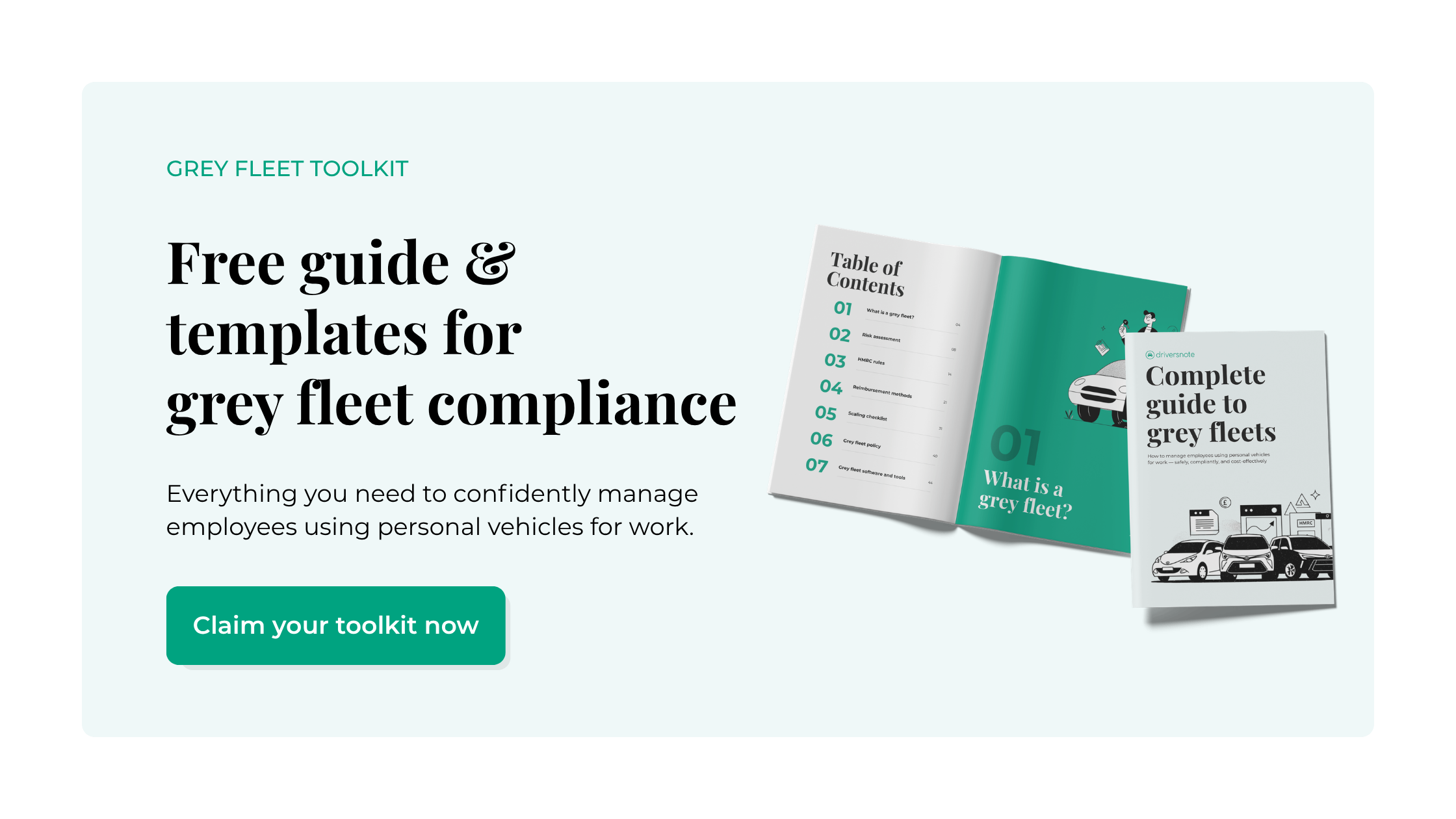
Download the grey fleet policy template to turn these principles into a usable policy your team can review, adapt, and roll out.
Pair it with a simple, consistent trip tracking process so employees log trips accurately, and your team has cleaner records for reimbursement, compliance, and day-to-day oversight.
Also read: ATO compliance for your grey fleet
FAQ
A grey fleet policy sets out the rules for employees using their own vehicles for work. It covers driver eligibility, vehicle standards, insurance requirements, journey records, incident reporting, and what happens if something goes wrong. It gives both the employer and employee a consistent process to follow.
There’s no single law requiring a document named “grey fleet policy.” But under the WHS Act 2011, employers must take reasonably practicable steps to manage work-related risks, which includes driving in personal vehicles for work. A written policy is the clearest way to demonstrate those steps are being taken.
Taking reasonable steps to ensure drivers are properly licensed, vehicles are safe and fit for purpose, insurance covers business use, and risks are actively managed. The policy doesn’t need to be complex — it does need to exist and be followed.
Usually not by default. A standard private-use comprehensive policy is designed for private and commuting use and typically doesn’t extend to work-related driving. Employees need to confirm with their insurer that business use is included — usually via a Class 1 Business Use endorsement or equivalent — and provide written confirmation before any work kilometres are reimbursed.
The ATO cents-per-kilometre rate (91 cents per km for 2026–27) is a tax deduction method for individuals, not a mandated reimbursement rate. Employers can choose to reimburse at this rate, above it, or below it. With proper per-kilometre records for actual business travel, reimbursements paid at or below the ATO rate are generally treated as a reimbursement of expenses — not taxable income — and are generally FBT-exempt. Confirm FBT and payroll treatment with your accountant for any arrangement involving allowances, novated leases, or mixed-use vehicles.
A named person in HR, operations, finance, or WHS — depending on how the business is structured. What matters is that one role has clear accountability for keeping the policy current, checking key documentation, and running the review cycle.
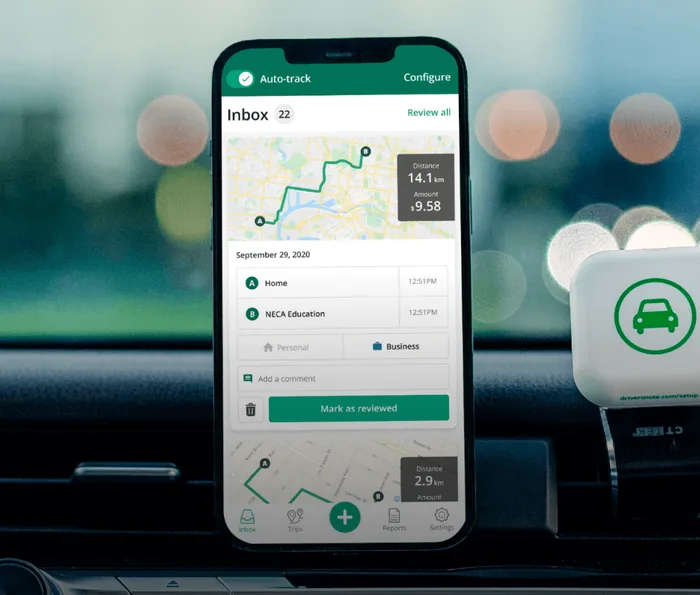
Tired of logging mileage by hand?
Effortless. IRS-compliant. Liberating.
 Auto-track trips
 Classify trips
 IRS compliant reports