Latest update: 26 August 2026 - 5 min read
A Vehicle Allowance and Mileage Policy Template for Care Sector Employers
If your care organisation is still handling vehicle allowances and mileage claims on a case-by-case basis, something will eventually slip — an unclear approval, a missing record, a driver who isn’t sure what counts as reimbursable. A written vehicle allowance policy template fixes that: it sets out, once and for all, who’s covered, what you’ll pay, and what you expect from anyone who drives their own car for work.
This free, downloadable mileage reimbursement policy template is built for the care sector, where staff move between home visits and often sit across different awards or agreements. In practice, it doubles as your grey fleet policy, covering any personally owned vehicle used for work. Adapt it, add your own numbers, and you’ve got a policy ready to roll out this week.
What’s in the template
The template is built around six practical pieces, pulled straight from how care providers actually operate day-to-day.
Scope and awards covered
Start by naming who the policy applies to: which roles, which vehicle types (employee-owned versus pool or fleet), and which award or agreement governs their allowance. Care providers often employ across several awards at once — home care, disability support, nursing and admin staff can all sit under different instruments — so this stops you applying one blanket rate where a different one legally applies.
Compensable travel vs. commuting
One of the most common disputes is what actually counts as work travel. The template draws a clear line: the daily commute to your first client or the office generally isn’t compensable, but travel between clients, to training, or on employer errands usually is. Spelling this out up front means staff, and whoever approves claims, aren’t guessing case by case.
Claim, approval and evidence requirements
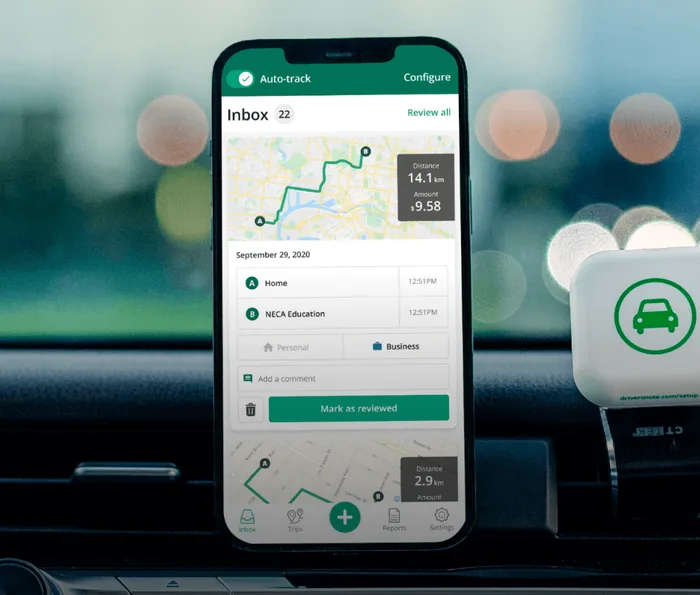
This sets the actual process: how staff submit a claim, who approves it, and what evidence they need. The template asks for a trip log or automatic mileage tracking and, where relevant, odometer readings, so every claim is backed by a record, not an estimate. If your team still fills in mileage claims by hand, a tool like Driversnote for Teams can capture that evidence automatically instead.
Safe driving expectations
Grey fleet duty of care doesn’t stop at your office door — it extends to an employee’s own car the moment they’re driving for work, with no minimum distance threshold. This section covers valid licences, vehicle roadworthiness, fatigue, and not driving in unsafe conditions, and points staff to a full risk assessment to ensure the policy and your everyday risk controls align.
Do you need a GPS/location tracking clause?
Only if you genuinely use GPS or location tracking. This clause is optional and clearly marked as such — if you don’t track vehicles, skip it.
If you do, check two things first. Health service providers are covered by the Privacy Act, even as a small business — the usual small-business exemption doesn’t apply once you hold health information. And workplace surveillance itself sits with state and territory law, not the Privacy Act: in New South Wales and the ACT, the Workplace Surveillance Act and the Workplace Privacy Act both require written notice before tracking starts, plus a clearly visible notice on the vehicle itself, with real penalties in the ACT for getting it wrong.
The template’s optional clause covers notice periods and data minimisation, so you’re not collecting more than you need.
Watch this space if you operate in Victoria. The Victorian government has given in-principle support to NSW/ACT-style workplace surveillance laws — advance notice periods and mandatory surveillance policies — timed around the November 2026 state election. It isn’t law yet, but if you run GPS or location tracking on Victorian staff, it’s worth revisiting this clause once (or if) that legislation lands.
How to adapt it for your organisation
The template is a starting point, not a finished policy. Confirm the award or agreement covering each part of your workforce, and enter the correct current vehicle allowance rate — mixed-award providers may need to list more than one rate side by side. This matters more right now than usual: from 1 September 2026 to 28 February 2027, a temporary Fair Work Commission increase puts SCHADS and Aged Care Award staff at $1.05/km while Nurses Award and Health Professionals and Support Services Award staff stay at $1.01/km, so a mixed-award policy needs to list both rates rather than one figure for everyone. Decide who signs off on claims and how often you pay them. And if any of your funding runs through a program with its own travel rules, check those against the policy before you finalise it, since funder requirements don’t always match award minimums.
How often should you update the policy?
Vehicle allowance rates aren’t set-and-forget. Most awards and agreements adjust rates around 1 July each year, so build an annual review into your calendar: check the current rate, confirm nothing’s changed in your relevant award, and update the template before the new financial year starts. A quick annual check now saves you from reimbursing staff at an outdated rate later, or underpaying them without realising it.
Download the template as a Google Doc
A clear vehicle allowance and mileage policy protects your staff and your organisation. It turns a recurring source of questions into something everyone can just follow. For vehicle risk beyond allowances and mileage, our grey fleet policy template covers the wider driver, vehicle and insurance requirements.
Get the Google Doc copied to your Drive and edit all applicable sections so the policy applies to your organisation, including the company name, roles and awards, and applicable rates and reimbursement methods, to start using it.
You can also find a GPS and location tracking clause in Appendix A of the template, should your organisation need it.
Tired of logging mileage by hand?
Effortless. IRS-compliant. Liberating.
 Auto-track trips
 Classify trips
 IRS compliant reports