Latest update: 26 August 2026 - 10 min read
Is Your Vehicle Allowance Exposing You to Fair Work Risk? A Self-Audit Checklist
If you run a care organisation in Australia, there’s a chance the Fair Work Ombudsman is already looking closely at your sector, and travel and vehicle allowances are a recurring area of concern.
In 2023–24 alone, the regulator recovered more than $40.5 million in underpayments for aged care workers. Its current inquiry into disability support services has also identified travel allowances as a live compliance issue, including in an active court case.
That doesn’t mean your organisation is doing anything wrong. But vehicle allowances are easy to set and forget, which means underpayments can quietly build up, particularly when employees regularly drive between clients as part of their work.
And getting vehicle allowances right across a mixed workforce isn’t always straightforward.
This is a ten-minute self-audit, not a formal investigation. Work through the questions, note anything you’re unsure about, and follow the links to dig deeper where needed.
It’s not a deep dive into day-to-day payroll administration, but designed for owners, MDs and board members who want a clear, sourced answer to one question: Are we exposed here?
Travel allowance per km: what Fair Work actually requires
There’s no single “Fair Work travel allowance per km” rate that applies to every employer. Under Fair Work’s system, a travel allowance — usually paid as a vehicle allowance to staff who drive their own cars between clients or sites — is set out in whichever modern award covers that employee, rather than as a single blanket national figure.
For most care sector awards — SCHADS, the Aged Care Award, the Nurses Award, and the Health Professionals and Support Services Award — the rate is indexed each year on 1 July as part of the Fair Work Commission’s Annual Wage Review, and currently sits at $1.01/km. That’s no longer identical across all four, though: a temporary Fair Work Commission Full Bench decision (case AM2026/10, [2026] FWCFB 224) lifts SCHADS and Aged Care Award vehicle allowances to $1.05/km from 1 September 2026 to 28 February 2027, while the Nurses Award and Health Professionals and Support Services Award stay at $1.01/km throughout.
That rate is a floor, not a fixed number, and it’s under active review right now, as the case further down this page shows — so re-check it again once the temporary SCHADS/Aged Care increase lapses on 28 February 2027. If you’re not confident which award’s travel allowance rate applies to which of your staff, or when it was last checked against the current figure, that’s exactly what questions 1 and 3 of the audit below are designed to surface.
What is the Fair Work Ombudsman’s Disability Support Inquiry finding?
In July 2025, the Fair Work Ombudsman opened a multi-year inquiry into the disability support services sector, citing “widespread, sometimes large-scale non-compliance” it had already uncovered in earlier investigations. The first phase, running roughly 18 months from launch, is fact-finding: talking to workers, providers, and platform operators to understand where and why underpayment happens.
The scale of what’s already on the record is worth knowing. Between January 2020 and December 2024, the regulator fielded more than 75,000 enquiries and 2,500 anonymous reports about the sector, closed over 3,000 matters, and recovered around $68 million in back-payments.
While that inquiry runs its course, enforcement hasn’t paused. Inquiries and litigation rarely start with a sector-wide audit. They usually start with one worker asking a question their employer couldn’t answer confidently.
What happened in Aged Care?
Aged care has already had its reckoning, and it’s a useful preview of what disability support inquiries tend to uncover. Cases like the two below are often reported in the media as wage theft examples, even though neither was prosecuted under the new criminal offence described further down this page — enforceable undertakings and self-reported errors are treated differently under Fair Work’s compliance framework than deliberate non-payment, but the back-pay bill lands the same way either way. Between early and mid-2025, the Ombudsman audited or interviewed 20 aged care providers across 27 sites in five states, recovering more than $40.5 million for over 22,000 underpaid workers in the 2023–24 financial year.
Two individual cases show how that adds up at the organisation level. Southern Cross Care (NSW & ACT) entered an enforceable undertaking in April 2026 to repay $11.7 million to 5,500 staff for underpaid overtime, weekend penalties, shift loadings, and other allowances. A separate, unrelated entity, Southern Cross Care (WA), self-reported its underpayments in December 2024 and signed an enforceable undertaking in May 2026, repaying $5.4 million to nearly 2,000 workers after its time-and-attendance systems were incorrectly configured.
More recently, Yooralla, a Melbourne-based disability support provider, signed an enforceable undertaking in July 2026 after self-reporting payroll errors that underpaid more than 1,300 staff by a combined $2.05 million. Individual back-payments in that case ranged from under a dollar to more than $22,000, which shows how unevenly these errors land once you look closely.
None of these organisations set out to underpay anyone. Each one found the gap through payroll and time-tracking issues that had been running for years before anyone noticed, and two of the three self-reported rather than waiting to be caught. That’s the pattern worth taking from aged care: the organisations that came out ahead were the ones that went looking before the regulator did.
What Fair Work penalties actually cost in 2026
The financial exposure here has gone up sharply, and it’s worth updating what you think you know. Civil penalties are calculated in “penalty units,” and that unit increased to $364 from 1 July 2026.
For a standard contravention, such as underpaying an allowance without any suggestion of deliberate conduct, the maximum penalty is $21,840 per breach for an individual and $109,200 per breach for a corporation. Where the conduct is found to be deliberate or part of a systematic pattern, it becomes a “serious contravention,” and the maximum jumps to $218,400 for an individual and $1,092,000 for a corporation, or three times the value of the underpayment, whichever is higher.
Each affected worker, in each affected pay period, can count as a separate contravention, which is how underpayment cases can turn into multi-million-dollar exposures so quickly.
In addition to civil exposure, since 1 January 2025, intentionally underpaying staff has been a criminal offence in Australia. Individuals can face up to 10 years in prison. Corporations face a fine of whichever is greater: 3 times the underpayment, or a fixed penalty-unit cap. Civil recovery is no longer the worst-case outcome, and a board that treats an allowance error as “just a payroll fix” once it’s found is applying yesterday’s risk model to today’s law.
Is there a case that could push vehicle allowances higher?
Possibly, and it’s worth checking the current status directly rather than treating any snapshot of it as final. In April 2026, the ACTU and Australian Unions launched a Fair Work Commission case, formally listed as AM2026/10 and joined matters, seeking to lift vehicle allowances across multiple modern awards by at least an extra 10 cents per kilometre and move the annual adjustment date forward from July.
The unions’ case rests largely on fuel costs: they argue petrol prices have risen faster than allowances have been adjusted, leaving workers who drive as part of their job effectively subsidising their employer every time they fill up.
Cases like this can take many months to move from submissions to a ruling, and the outcome can shift the situation from “under consideration” to “decided” with little warning. If the Commission grants the increase, any organisation still paying the old rate would fall behind the award minimum overnight, through no fault of its own.
The case is a reminder that a vehicle allowance isn’t a “set and forget” figure. It’s tied to an award rate that a regulator, a union, or the Commission itself can move, sometimes with very little public warning, and to fuel and running costs that shift independently of any award review.
Organisations that check their rate once a year, tied to the annual adjustment date, are far less likely to be caught out than those that set it once and never revisit it. That’s easier to promise than to do when the rate lives in a spreadsheet or an old policy document that nobody’s specifically responsible for updating.
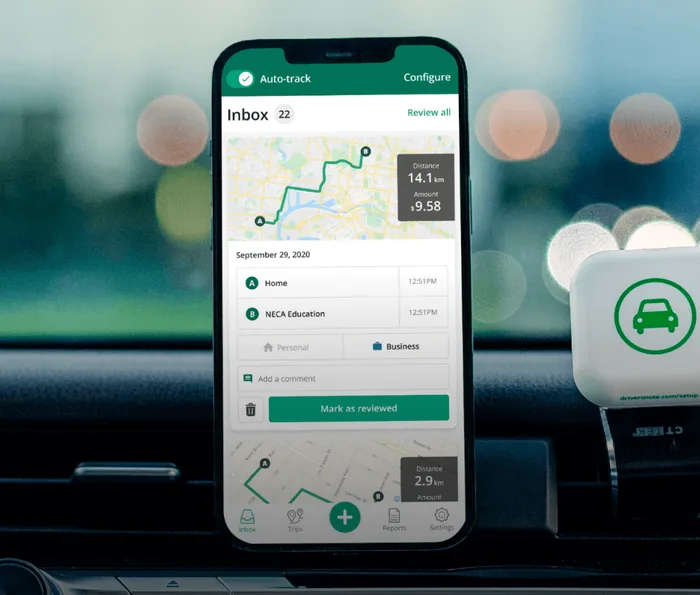
It also assumes your mileage tracking tool can actually maintain that rate. A SCHADS or other award rate isn’t the standard ATO rate, so it needs to be set up as a custom rate rather than left on a default. Held centrally like that, updating it is easier: change the custom rate once when the award moves, and the worker’s trips are calculated against the new figure from that point on, instead of everyone working off whatever number they were last told.
Your 10-minute vehicle allowance self-audit checklist
Work through these five questions. If you can’t answer one confidently, that’s your starting point.
1. Do you know which award, or awards, actually apply to your workers? Many care organisations employ staff across more than one award, or have workers whose classification has changed without their allowance being reviewed. If you’re not certain, start by confirming which award applies to your workers before you check anything else.
2. Do you track inter-client travel time separately from ordinary commuting? Under SCHADS and similar awards, time and distance spent travelling between clients during a shift is treated very differently from a worker’s commute to their first appointment. Providers that only log visit start and end times, without separating out the travel segments in between, are one of the most common sources of underpaid travel time and vehicle allowances in this sector. The fix doesn’t have to be manual: automatic tracking that lets a worker categorise each trip as business or private gives you a clean split between client-to-client travel and the commute either side of it, rather than trying to reconstruct that split from notes or spreadsheets after the fact.
3. Is your allowance rate current as of the last 1 July update? Award rates, including vehicle allowances, are typically adjusted annually. A rate that was correct last year can quietly fall behind without anyone updating it, particularly if it’s set manually in a spreadsheet or payroll template rather than reviewed each year.
4. Do you know whether your allowance exceeds the ATO reasonable rate, and if so, whether that’s being reported correctly? Paying above the ATO’s reasonable rate isn’t a compliance problem in itself, but the excess generally needs to be treated as assessable income unless it’s properly substantiated. Use our Payroll Guide & Calculator to see if any of the allowance is taxable for your team. Skipping this step creates a tax exposure that sits alongside, not instead of, your Fair Work risk.
5. Do you have a written vehicle allowance policy? A documented policy gives your payroll team, managers, and auditors a single source of truth, and it’s one of the first things the Fair Work Ombudsman asks to see in an investigation. If your current approach lives in someone’s memory or an old email thread, that’s a gap worth closing regardless of what your audit finds elsewhere.
Tired of logging mileage by hand?
Effortless. IRS-compliant. Liberating.
 Auto-track trips
 Classify trips
 IRS compliant reports