Latest update: 26 August 2026 - 10 min read
What Is Manual Mileage Tracking Really Costing You?
Nobody in a care business decides to spend thousands of dollars a year on mileage admin. The cost creeps in a minute at a time, spread across workers, managers, payroll and finance.
That’s what makes manual mileage tracking deceptive. The spreadsheet is free. The paper logbook is free. But underneath them sit very real costs for the business: the time spent administering mileage, travel you could have billed but didn’t, and mileage you’ve paid or claimed without the records to back it up.
So let’s bring all hidden costs into view. Our calculator does the arithmetic. You just need four numbers, and the worked examples below show you where to find them and what the result can look like.
After that, two things determine whether switching actually works in practice: what your workforce can realistically absorb, and what the law says about tracking employees who drive their own cars.
Every figure below is illustrative. Swap in your own numbers, and the result changes.
Why manual mileage tracking costs more than you think
The admin time nobody counts
Writing down a trip by hand takes about 90 seconds if you do it in the car before pulling away: the odometer reading at the start, the odometer reading at the end, the address, the purpose, and which client the trip relates to.
But that’s rarely how it happens. More often than not, your vehicle logbook is reconstructed at the end of the day or on Friday afternoon for the whole week. That means opening the roster, checking the calendar, working out which visit came before which, and estimating distances you can no longer measure accurately.
That turns a 90-second task into several minutes per trip, and usually produces worse data.
Even using the optimistic 90-second figure, the time adds up quickly. Five workers making six visits a day means 30 trips, or 45 minutes of team time every day. Over a year, that’s around 180 hours. It rarely appears in a budget because mileage admin is never anyone’s whole job.
Then there’s the work that lands on other desks: chasing down missing submissions, checking entries that don’t add up, correcting mistakes, and getting everything processed before payroll closes.
The travel you never invoice
Manual vehicle logbooks don’t just cost your business time. They under-record.
Trips get forgotten between the client’s driveway and the end of the shift. A quick detour to drop off equipment doesn’t feel worth writing down. A worker who’s had a difficult visit isn’t reaching for a logbook.
Two things happen to every kilometre that goes unrecorded. You can’t claim it against a participant’s plan, so it’s revenue you were entitled to and never invoiced. And your worker drove it without being reimbursed.
That second half is easy to miss. Under the SCHADS award, a worker is entitled to $1.01 a kilometre for authorised use of their own car — trips between clients, not the commute to the first one — temporarily $1.05 a kilometre from 1 September 2026 to 28 February 2027 under a Fair Work Commission increase for SCHADS and Aged Care Award staff. That vehicle allowance doesn’t depend on whether the trip was logged. If the drive happened, the cost happened too, and until it’s reimbursed, it’s your worker covering the petrol.
Records that don’t survive being questioned
The third cost only arrives occasionally, and it’s the largest.
NDIS claims aren’t vetted before they’re paid. They’re sampled afterwards through the National Disability Insurance Agency (NDIA) payment assurance program, which asks providers to produce evidence for claims they’ve already been paid for. Failing to produce complete records may result in repayment of the funds. That’s money you’ve already received and spent on wages, and now have to find again.
The penalties sit on top of that. The NDIS Amendment (Integrity and Safeguarding) Act 2026 sharply increased civil penalties for serious contraventions, so a pattern of unevidenced claims is a bigger problem than a single repayment.
Then there’s the employment side. Under section 557C of the Fair Work Act, if you haven’t kept the records you’re required to keep and a worker alleges an underpayment, you carry the burden of disproving it. You’re proving a negative, from memory, about trips somebody else took. Learn more in our Fair Work vehicle allowance audit.
The retention rules make that harder again: Fair Work wants seven years of employee records, including allowances. The ATO wants five for logbooks and receipts. They stack rather than replace each other, so you design for seven years.
That’s the part that manual tracking can’t realistically deliver. Seven years of paper logbooks and spreadsheet tabs, one set per worker, still findable after an office move and a few rounds of staff turnover. Our guide to mileage log requirements sets out what a compliant record contains, which is a fair test of whether your current method would hold up under scrutiny.
How do you work out what manual tracking is costing you?
You need four numbers:
- How many staff drive for work
- Average kilometres per worker — or visits per day, if that’s easier
- Your reimbursement rate — whether that’s an award rate, the ATO rate, or a flat allowance converted to a per-kilometre figure
- A blended hourly cost for admin time, including on-costs
Then add two assumptions. Ask a couple of drivers how long they actually spend logging trips, and whoever processes claims, how much time goes into chasing, checking and correcting them.
If you need a starting point, the examples below use 90 seconds per trip and 15 unrecorded kilometres per worker per week. They’re conservative placeholders, not benchmarks, so replace them with your own numbers when you can.
What the answer can look like
Using $1.05 per kilometre (the temporary SCHADS/Aged Care rate, 1 September 2026 to 28 February 2027 — use $1.01 outside that window) and $40 per hour:
| 5 workers | 80 workers | |
| Admin time | 180 hours / $7,200 | 880 hours / $35,200 |
| Travel never invoiced | 3,600 km / $3,780 | ~$30,000 |
| Annual total | ~$11,000 | ~$65,000 |
These aren’t benchmarks. The point is that even a small team can spend more on manual mileage than on replacing it.
Free tool
What is manual mileage tracking costing you?
Enter your team's numbers to see the hidden cost of paper logbooks and spreadsheets — and what changes with automatic tracking.
Run your own numbers through the calculator above, and you’ll have a much better estimate.
And that’s before you look at who does the admin
HESTA’s State of the Sector research identifies under-resourcing, stress and salary as major pressures across disability and community services. One of its recommendations to employers is to reduce systemic red tape.
Mileage admin is a small example, but a frequent one. Workers have to choose between recording trips properly and getting on with client care. The result can be more admin and worse records.
Technology only helps if it removes work. HESTA also found that only around half of employees who had new technology introduced felt adequately prepared to use it.
So judge any replacement on two things:
- Does it remove steps from the worker’s day? If someone still has to remember to start and stop every trip, you haven’t removed much.
- Can you support the rollout? Budget for onboarding and choose a user-friendly tool.
Can you track mileage in employees’ own cars?
Yes, but tracking a worker’s own vehicle raises privacy and workplace-surveillance questions that don’t apply in quite the same way to a company car.
Safe Work Australia lists vehicle tracking as one possible control for work-related driving risks in the health care and social assistance sector. But the rules around notice and consent vary by state and territory.
For example:
- New South Wales generally requires advance written notice and restricts tracking outside work under the Workplace Surveillance Act 2005.
- The ACT also has workplace-surveillance notice requirements.
- Other jurisdictions rely more heavily on privacy, consent, and general employment law principles.
The practical rule is simpler: avoid collecting more information than you need.
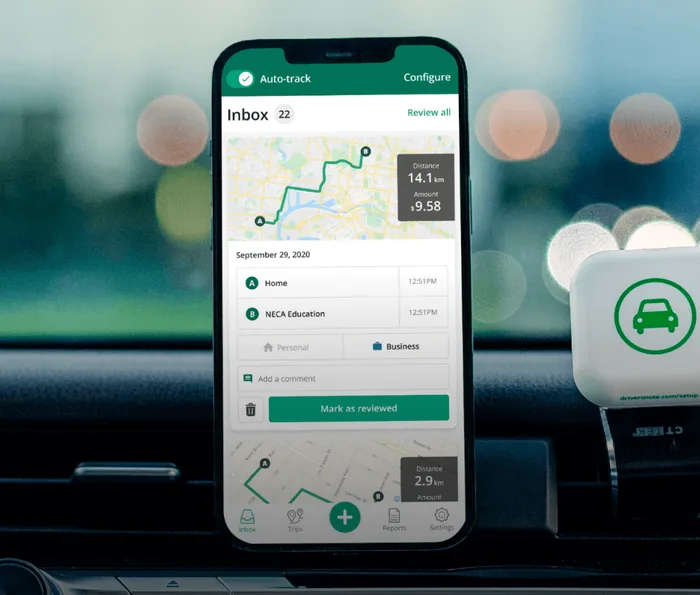
That makes continuous telematics a poor fit for many personal vehicles. A vehicle logbook app can work differently: trips can be recorded during defined periods, the worker reviews them, and only the trips they choose to submit reach the employer.
Three things matter:
- Tracking is limited to work.
- Workers review their own trips before submitting them.
- Recording is automatic, rather than another task they have to remember.
That gives the employer the mileage reports without turning the worker’s private car into a continuously monitored company vehicle.
Do you need mileage software if you already have NDIS software?
Maybe. The question isn’t whether your existing system has a mileage field. It’s whether the record it produces is good enough and if it’s user-friendly.
Check four things:
- Accurate: distance is recorded automatically rather than reconstructed later.
- Private: workers control what they submit.
- Easy: recording doesn’t add another step to every visit.
- Usable: the record can support payroll, reimbursement and later review.
If your existing platform does all four well, you may not need anything else.
If it doesn’t, a dedicated mileage tool can sit alongside it rather than replace it. Our guide to choosing an ATO-compliant log book app covers what to look for.
Where to start
-
Start with your own numbers: staff who drive, kilometres travelled, reimbursement rate and admin cost.
- That tells you whether you have a small inconvenience or a material cost.
-
Then ask two questions the spreadsheet can’t answer:
- Will the new process genuinely make life easier for workers?
- Can you introduce it in a way that respects privacy and workplace-surveillance rules?
If the numbers justify a change, automatic mileage tracking for teams can remove most of the recording step. Trips are logged automatically, workers review what they submit, and managers get a cleaner record without chasing paper logs.
Tired of logging mileage by hand?
Effortless. IRS-compliant. Liberating.
 Auto-track trips
 Classify trips
 IRS compliant reports