Latest update: 26 August 2026 - 10 min read
FBT and Salary-Packaged Cars: What Healthcare Employers Need to Know
If you run HR or finance for a not-for-profit hospital, aged care provider or ambulance service, your organisation has an FBT exemption that most employers don’t get. If you run a for-profit clinic offering novated leases or salary-packaged cars to staff, you almost certainly don’t have that exemption, but you might be paying more fringe benefits tax than you need to.
This article covers both situations. First, the real exemption cap available to public hospitals, NFP hospitals and ambulance services, and its limits. Second, and this is the part most FBT guides skip, the record-keeping choice that decides whether a for-profit clinic’s salary-packaged car is taxed on a flat rate or on what it’s actually used for.
Whether a salary-packaged car is FBT-exempt for your organisation or you’re working out how to bring the bill down, the mechanics below apply either way.
In short: Public hospitals, NFP hospitals and ambulance services can provide up to $17,000 of grossed-up benefits per employee per year — including a salary-packaged car — with no FBT payable. Everyone else pays FBT on a salary-packaged car, but how much depends on which of two valuation methods you use (the flat statutory formula method, or the usage-based operating cost method), and a logbook can lower the bill either way.
The FBT exemption for public hospitals, NFP hospitals and ambulance services
Public hospitals, not-for-profit hospitals operated by a charity, and public ambulance services get a dedicated FBT exemption. It doesn’t mean every benefit you provide is automatically tax-free, but it does mean you have real room to provide benefits like salary-packaged cars before FBT becomes payable. Aged care providers structured as charities or public benevolent institutions fall under a related concession, which is why salary packaging a car tends to come up so often when aged care employers discuss staff benefits.
The FBT-exempt $17,000 cap
Each employee gets an exemption cap of $17,000 (grossed-up value — the taxable value of a benefit scaled up to reflect the pre-tax income an employee would have needed to buy it themselves, which is what FBT is actually calculated on) per FBT year. If the total grossed-up value of the fringe benefits you provide an employee, including a salary-packaged or novated-lease car, sits at or below that figure, those benefits are exempt from FBT entirely. A separate cap of $5,000 applies specifically to salary-packaged meal entertainment and entertainment facility leasing benefits, so you should track these benefits independently rather than lumping them in with the car benefit.
The cap applies per employee, and it applies in full even if someone worked only part of the FBT year. It isn’t pro-rated down for a new starter or someone who left partway through the year, which is a detail worth flagging to payroll if you’re checking exposure mid-year.
What happens if you go over the cap?
Once the grossed-up value of an employee’s benefits goes over $17,000, your organisation calculates and pays FBT on the excess, not on the whole amount. This is where knowing the exact car benefit value you provide matters, because it determines how much of the cap a salary-packaged car uses up, and how much room staff have left for other benefits exempt from FBT.
The choice between the two car valuation methods — the statutory formula method (a flat percentage of the car’s value, regardless of how it’s actually used) or the operating cost method (based on actual running costs and a logbook-verified private-use percentage) — still matters for exempt employers, not just for-profit ones. A lower taxable value on the car leaves more of the cap available for everything else.
In practice, that means a hospital or aged care provider with several staff close to the $17,000 mark has just as much reason to check whether the operating cost method would bring a car’s taxable value down as a clinic with no exemption at all.
Salary packaging a car: How it works
Salary packaging a car — usually set up as a novated lease — lets an employee use part of their pre-tax salary to cover a car’s lease payments and running costs, with the employer administering the arrangement rather than owning the vehicle outright. For healthcare employers, it’s a common way to help staff access a car without buying one outright, and it comes up especially often for people who drive heavily for work, like home-visit allied health professionals, GPs doing house calls, and community nurses covering aged care clients.
Whether or not your organisation is FBT-exempt, a salary-packaged car is still a reportable fringe benefit, and its taxable value has to be worked out one of two ways. That calculation determines how much of your exemption cap the car uses up, or how much FBT a for-profit clinic actually pays.
How salary-packaged cars are taxed
A company car and a salary-packaged one sit in slightly different brackets, but the same FBT valuation rules apply to both. That taxable value is calculated one of two ways, and the choice between them is entirely up to you each FBT year, independent of whichever method you used the year before.
The statutory formula method
Most clinics default to this without ever comparing it to the alternative. The statutory formula method sets the taxable value at a flat 20% of the car’s base value, adjusted for the days it was available for private use. It doesn’t matter whether the car is used 10% or 90% for work; the taxable value comes out the same either way. It’s simple to administer, which is why it’s the default, but for a car that’s genuinely a work vehicle most of the time, it tends to overstate the taxable value.
The operating cost method
The operating cost method calculates the taxable value from the car’s actual running costs, including deemed depreciation and interest, multiplied by the private-use percentage. For a car used mostly for home visits, the private-use percentage can be low, which lowers the taxable value.
You can only use this method if you’ve established the private-use percentage through a valid logbook. Without one, you default back to the flat statutory rate. Our guide to ATO logbook requirements covers exactly what a compliant logbook needs to contain.
A logbook can lower your FBT bill, not just your income tax
For a home-visit physio, a GP doing house calls, or a community nurse covering aged care clients, the car is doing real, trackable work. The gap between the statutory formula and the operating cost method for a vehicle like that isn’t marginal. It’s often the difference between a flat 20% and a private-use percentage in the single digits, and that gap only becomes real money if there’s a valid logbook to back it up.
Maintaining a valid logbook for FBT purposes
A valid logbook records a continuous 12-week period that’s representative of the car’s business use. Once established, it remains valid for five years, after which you need a new one, provided driving patterns remain the same over that period. On top of the logbook itself, you need odometer readings for the full FBT year, not just the 12-week window, to apply the business-use percentage across the whole period. Missing either piece means falling back to the statutory formula, even if the logbook period itself was done correctly.
Electric car FBT exemption: What changes from April 2027
Electric vehicles often come up in salary packaging conversations in this sector, and the rules here are evolving. Eligible zero and low-emissions cars priced under the luxury car tax threshold for fuel-efficient vehicles currently qualify for a full FBT exemption or discount when salary packaged, which is a meaningful addition on top of whatever exemption cap or method choice you already apply.
That said, this is changing from 1 April 2027, following the government’s May 2026 Federal Budget announcement. The current full exemption holds for the FBT year ending 31 March 2027. From the following FBT year, eligible EVs priced at $75,000 or under keep a 100% discount, while EVs priced above $75,000 but still under the luxury car tax threshold move to a 25% discount instead of a full exemption. If you’re weighing an EV novated lease that runs past that date, check the live thresholds on ato.gov.au before committing, since this is exactly the kind of detail that shifts with each Budget.
What to track either way
Regardless of which category your organisation falls into, your record-keeping job is the same: a continuous 12-week logbook when you first elect the operating cost method, full-year odometer readings to apply the resulting business use percentage, and a note of which method you’re using each FBT year so you can compare it against the alternative before you lodge. For exempt employers, add the grossed-up value of each employee’s benefits against the $17,000 cap, and the meal entertainment total against its separate $5,000 cap, so nobody’s caught out mid-year.
Doing this well usually comes down to timing. Start the 12-week logbook window early enough in the FBT year to genuinely reflect normal driving, rather than a quiet or unusually busy patch, and record the odometer readings for the full year rather than assuming the 12-week sample covers everything. Whoever manages salary packaging, whether that’s HR, finance, or an external provider, needs visibility into both numbers before the FBT return is due.
This can be somewhat mechanical: know your numbers, keep the records the method requires, and choose the method that produces the lower taxable value each year. Setting up a fair company car policy is a good place to put these expectations in writing so drivers know what’s required of them from day one.
Which category are you in?
Public hospital, NFP hospital or ambulance service: check each employee’s total grossed-up benefits against the $17,000 cap, and meals and entertainment separately against the $5,000 cap.
For-profit clinic or practice: you’re not exempt, so how you value each salary-packaged car matters. If a vehicle is used heavily for work, a 12-week logbook plus full-year odometer readings may produce a lower taxable value under the operating cost method.
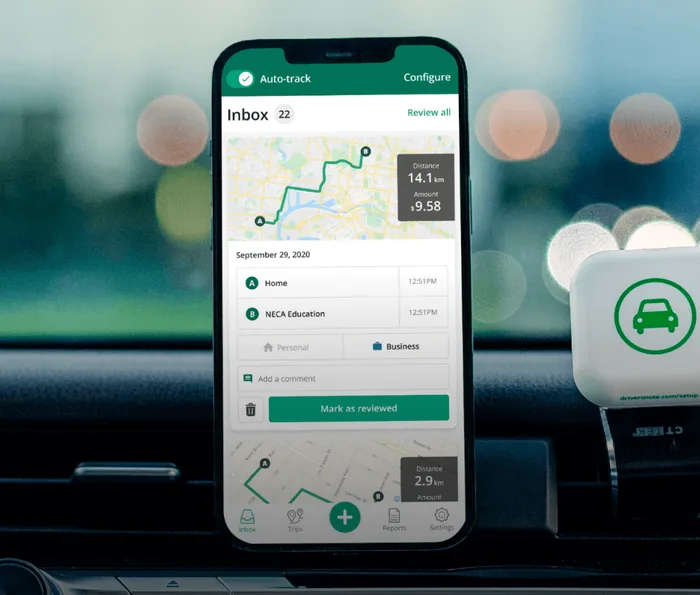
Either way, the records you need are the ones your clinicians may already be keeping for their own car allowance or company car decisions and taxes. With Driversnote Teams, trips are logged automatically, and odometer records stay complete across the FBT year, so you can compare methods using real data rather than estimates.
Tired of logging mileage by hand?
Effortless. IRS-compliant. Liberating.
 Auto-track trips
 Classify trips
 IRS compliant reports