Latest update: 26 August 2026 - 30 min read
Payroll Guide & Calculator: Is SCHADS Travel Allowance Taxable?
A payroll guide to the SCHADS Award travel allowance rate, the ATO’s cents-per-km rate, and what it takes to get PAYG withholding right for every employee on your team.
If your organisation employs people under the SCHADS Award who use their own cars for work, two amounts apply to each employee: the SCHADS car allowance and the ATO’s cents-per-kilometre rate of $0.91.
The SCHADS Award sets what you owe: a car allowance of $1.01 per kilometre for 2026–27 for required, authorised work travel — temporarily $1.05 per kilometre from 1 September 2026 to 28 February 2027, under a Fair Work Commission Full Bench decision (case AM2026/10, [2026] FWCFB 224). The Aged Care Award moves with SCHADS during that window; the Nurses Award and the Health Professionals and Support Services Award stay at $1.01 throughout, and re-check the rate after 28 February 2027 when the temporary increase lapses. The ATO sets a separate rate, $0.91 per kilometre for the 2026-27 tax year, which determines how much of that payment is tax-free.
This guide covers what counts as an allowance versus a reimbursement, why part of the SCHADS travel allowance is taxable, what changes once an employee passes 5,000 kilometres in a year, and includes a calculator so you can check the numbers for your own team.
Allowance or reimbursement?
The SCHADS Award and the ATO describe the same travel payment differently, and this affects how you treat it.
The SCHADS Award refers to the per-kilometre payment as a reimbursement. It exists to cover the cost of an employee using their own vehicle for work, not to top up their income.
The ATO refers to the same payment as a car expense allowance. That’s because it’s a set rate per kilometre, rather than a dollar-for-dollar refund against a receipt. A cents-per-kilometre payment is a predetermined estimate of running costs (fuel, wear and tear, servicing) in the ATO’s eyes, whatever the Award calls it.
A genuine reimbursement, such as refunding a toll or a parking fee against a receipt, is different again. It’s an exact refund of money the employee already spent, and it isn’t taxed. For the general picture of how these terms apply across Australian pay setups, see our guide to car allowances in Australia.
Quick reference: what’s what
| Payment type | What it actually is | Who sets the rate | Is it taxable? | Counts toward super? |
|---|---|---|---|---|
| SCHADS travel allowance (per km) | Compensation for an employee using their own car for required, authorised work travel | SCHADS Award (Fair Work) sets the minimum — $1.05/km from 1 Sept 2026 to 28 Feb 2027, $1.01/km outside that window | Partly — the ATO’s $0.91/km portion is tax-free, the rest isn’t | Not up to the ATO rate; the excess isn’t automatically OTE either |
| ATO cents-per-km rate | Not a payment itself — the ceiling the ATO treats as covering genuine running costs | Australian Taxation Office | N/A — it’s a threshold, not income | N/A |
| Flat car allowance (fixed weekly or monthly amount) | An unconditional amount, unrelated to kilometres actually driven | Employer or enterprise agreement | Fully taxable from the first dollar | Yes — treated as ordinary income |
| Reimbursement against a receipt (tolls, parking, etc.) | A dollar-for-dollar refund of a specific, already-incurred cost | N/A — it matches the actual expense | Not taxable | No |
Whether a reimbursement is taxed as income depends on whether it’s genuinely dollar-for-dollar or a rate-based estimate, such as the SCHADS vehicle allowance.
Two rates, one payment: what you owe and how much of it is taxed
Fair Work sets what you owe. The SCHADS rate is a wage entitlement, so paying an employee only the ATO’s $0.91 to simplify the tax side is an underpayment of wages, not a shortcut. It applies in full, regardless of how you plan to withhold tax on it.
The ATO sets how much of what you pay is taxed, using its cents-per-kilometre method. $0.91 is treated as covering genuine running costs and isn’t taxed. The rest doesn’t match any cost estimate, so PAYG withholding applies to it from the first kilometre — a 10-cent gap at the standard $1.01 SCHADS rate, or a 14-cent gap while the temporary $1.05 SCHADS/Aged Care rate applies (1 September 2026 to 28 February 2027).
The 5,000km cliff
The ATO’s tax-free treatment isn’t unlimited. It caps out at 5,000 business kilometres per vehicle, per employee, per financial year.
Under 5,000km, only the gap between the SCHADS rate and the ATO rate is taxable for that employee — 10 cents normally, 14 cents while the temporary $1.05 rate applies. Past 5,000km, the tax-free treatment disappears entirely for every kilometre beyond it, so the full SCHADS rate becomes taxable, not just the difference.
What changes for your business once an employee passes 5,000km?
The withholding treatment for that employee changes for the rest of the financial year: instead of withholding tax only on the per-kilometre gap, you withhold tax on the full SCHADS rate for every kilometre beyond 5,000.
Employees who drive more than 5,000 km a year may also consider the logbook method for their tax return once they’re past the cap, since it has no kilometre ceiling. That’s a personal tax matter for them, not something you need to manage, but it’s worth knowing so you can explain why their pay looks different partway through the year. The logbook method versus cents-per-km comparison covers the employee side in more detail.
Why this is so easy to get wrong across a team
It might not be complicated for one employee, one trip. But it gets harder as soon as you’re managing it across a whole team, all year, without a single place that shows exactly how many kilometres each person has driven.
A spreadsheet or an estimate can’t reliably flag the exact day an individual employee crosses 5,000km, and with several staff on different schedules, that date will vary for everyone. It also can’t cleanly separate time spent driving between clients, which is paid at the ordinary hourly rate on top of the per-kilometre payment, from the distance itself. Blending the two into a single rate is a wage underpayment.
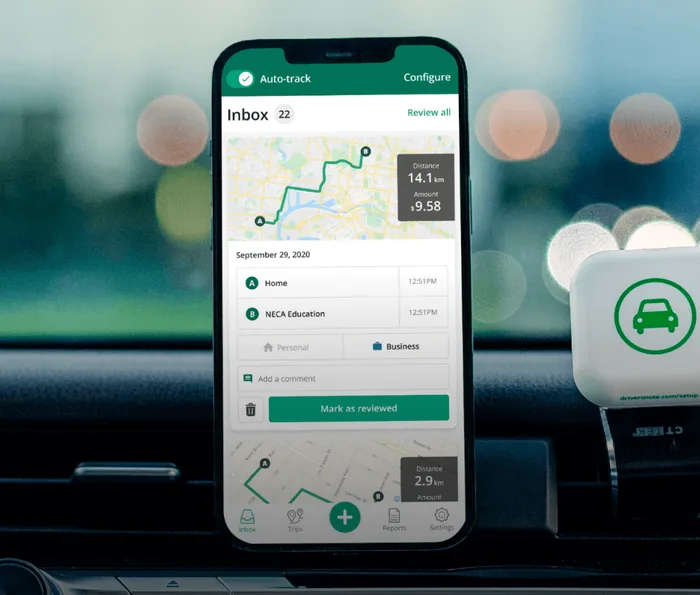
Automatic mileage tracking addresses this problem directly: every employee’s trips can be logged as they happen, so you have an accurate, per-person kilometre count without chasing anyone for a manual log or guessing when someone’s crossed the threshold.
Check the numbers for your team: try the calculator
The rates and the cap are the same for every employee, but the dollar figures aren’t. Enter an employee’s annual business kilometres and marginal tax rate below to see the gross payment, the tax-free and taxable portions, the PAYG to withhold, and the net amount payable.
Switch to the “For managers & payroll admins” view for the payroll cost and reporting detail — it also flags the STP Phase 2 reporting category to use and whether the Super Guarantee applies, so it’s not just the PAYG figure you’re checking per employee.
Vehicle Allowance and Tax Calculator
Estimate your SCHADS Award vehicle reimbursement and PAYG tax withholding under the ATO cents‑per‑kilometre method.
Estimate the payroll cost, PAYG withholding obligation, and compliance notes for an employee's SCHADS vehicle reimbursement.
Advanced settings
Estimated breakdown
Compliance notes
- SCHADS Award rate applies once travel is required and authorised for the role (Award clause 20.7(a)) — this is a legally enforceable minimum reimbursement.
- Track cumulative year-to-date km per employee. The ATO rate is only tax-free up to the km cap above; withhold PAYG on every km driven above it, for the rest of the financial year.
- Cents-per-km reimbursements are exempt from Super Guarantee — they're treated as an expense reimbursement, not ordinary time earnings.
- The employee's private vehicle is a workplace while used for work purposes — employers retain standard WHS duties for it.
- Single Touch Payroll (STP) Phase 2: report the whole cents-per-km reimbursement — both the tax-free and taxable portions above — as one "Cents per km" allowance (allowance type CD). Don't move the excess into ordinary gross wages: per the ATO, type CD covers cents-per-km amounts both within and above the ATO rate/km limit; that limit only changes how much PAYG to withhold, not which STP category it's reported under.
Estimate only, for general information. Once your cumulative business kilometres for the year pass the tax‑free cap, the SCHADS rate exceeds the ATO rate and the excess becomes subject to PAYG withholding — actual amounts depend on your employer's payroll settings and current SCHADS Award / ATO cents‑per‑kilometre determinations. Track your trips automatically with Driversnote.
Estimate only, for general payroll-planning purposes — confirm figures against the current SCHADS Award and ATO cents‑per‑kilometre determination before processing pay runs. Super Guarantee exemption assumes the payment stays a genuine cents-per-km reimbursement. STP Phase 2 categorisation per the ATO's STP Phase 2 allowances guide — confirm with your payroll software provider, since exact field names vary. Automate mileage records for your whole team with Driversnote.
Quick answers for the questions your employees will ask
“Why did my pay change partway through the year?”
They’ve likely passed 5,000 business kilometres for that vehicle. Below the cap, only the 10-cent gap is taxed. Above that, the ATO no longer allows any tax-free treatment for the extra kilometres, so the full $1.01 becomes taxable for every kilometre beyond 5,000. The rate they’re paid hasn’t changed; only the tax treatment has.
“Do you pay super on a SCHADS vehicle allowance?”
Not on the portion that matches the ATO’s cents-per-kilometre rate. Superannuation applies to Ordinary Time Earnings (OTE), and a vehicle allowance paid at or below the ATO’s benchmark rate generally isn’t treated as OTE. If any part of what you pay sits above that rate, or if you pay a flat, unconditional car allowance instead of a per-kilometre one, that excess (or the whole flat amount) is typically OTE, and the Super Guarantee applies to it. Check with your payroll software or a registered tax/BAS agent if you’re unsure which category a specific payment falls into.
“Do I need to do anything on my own tax return?”
Possibly, and this one’s for a registered tax agent or the ATO, not you. The full $1.01/km typically appears on their income statement as income, and they may be able to claim a matching deduction using the cents-per-kilometre method, up to 5,000km.
Where manual tracking runs out of road
One employee, one vehicle, one fairly simple split between the SCHADS rate and $0.91. Multiply that by a roster of support workers, each with different shifts, different clients, different awards, and different odometer readings, and those numbers get a lot harder to apply consistently — especially with SCHADS and Aged Care sitting at a different rate to Nurses and HPSS until 28 February 2027.
That’s the part worth automating. When every trip logs itself the moment it’s driven, nobody’s chasing a manual log or guessing which day someone hit 5,000km. Automatic mileage tracking for your team turns the numbers behind the calculator above from an estimate into a record of what actually happened on the road.
Tired of logging mileage by hand?
Effortless. IRS-compliant. Liberating.
 Auto-track trips
 Classify trips
 IRS compliant reports