Latest update: 26 August 2026 - 10 min read
NDIS Travel Allowance: What Can You Claim and How?
If you run an NDIS business, you can claim travel time and vehicle costs for support workers travelling to participants separately from the support you provide. Both charges, however, need to be agreed with the participant in advance.
This guide explains how NDIS provider travel works, including what you can charge per kilometre, how the rules apply to support workers, other travel costs providers need to account for, upcoming changes, and the most common mistakes that cause problems. If you also provide Support at Home services, we will compare the two schemes near the end.
What is the NDIS travel allowance?
The NDIS travel allowance has two parts:
- Labour: the support worker’s travel time
- Non-labour: vehicle costs such as fuel, wear and tear, tolls and parking
Both must be agreed with the participant in advance and included in the service agreement before you bill for them. Skip that step, and the travel isn’t claimable, no matter how well you’ve recorded it.
NDIS travel allowance for support workers
Support workers are usually the ones absorbing the day-to-day reality of NDIS travel, so it’s worth knowing exactly what they’re entitled to and how it’s meant to be paid.
How much travel time can support workers claim?
A support worker’s time getting to and from a participant is claimable, but the limit depends on location under the Modified Monash Model (MMM), the classification used to define remoteness. In metro and regional centre areas (MMM1–3), that’s up to 30 minutes each way. In regional areas (MMM4–5), it rises to 60 minutes each way. In remote and very remote areas (MMM6–7), there’s no time limit.
Travel time for support workers is generally charged at the same rate agreed for the primary support, or lower if that’s what’s agreed. That’s different from therapy supports, where travel time is capped at half the regular price limit, so it’s worth not assuming the same rule applies across every support type you deliver.
Either way, travel time is paid time, separate from time spent delivering support, and it should appear as its own line in your records and on the invoice, not folded into the support itself.
Who covers the gap between NDIS and Award rates?
In addition to travel time, providers can claim a non-labour amount to cover vehicle costs, capped at the NDIS non-labour travel limit of $0.99 per kilometre.
Here’s where it gets tricky. The SCHADS Award sets the minimum rate for a disability support worker’s use of their own car at $1.01 per kilometre from 1 July 2026 — but from 1 September 2026 to 28 February 2027, a temporary Fair Work Commission increase (case AM2026/10) lifts that to $1.05 per kilometre. That widens the gap between what you owe the worker and what you can recover from the NDIS: normally two cents per kilometre, but six cents per kilometre while the temporary increase is in effect. It reverts to a two-cent gap once the increase lapses on 28 February 2027.
In practice, employers need to absorb that gap themselves rather than pass it on to the participant’s plan. For a support worker doing several visits a day, it adds up — more so while the six-cent gap applies. This is one more reason accurate per-trip records matter: they tell you exactly what you owe the worker under the Award and exactly what you can recover from the NDIS, rather than leaving both figures as guesswork. It’s also worth understanding how mileage reimbursement works for employees more broadly, since the same recordkeeping principles apply.
How much is the NDIS travel allowance in 2026?
The NDIS travel allowance per km for vehicle costs is $0.99, and travel time is claimable within the usual price limits for the support being delivered.
It helps to know how that compares with two other rates you’ll come across:
- The SCHADS Award vehicle allowance, set at $1.01 for 2026-27, temporarily $1.05 from 1 September 2026 to 28 February 2027.
- The ATO’s cents-per-kilometre rate for using a personal car for work purposes is set at 91 cents per kilometre for 2026–27.
These three rates serve different purposes: an NDIS claim limit, an award-mandated reimbursement, and a tax deduction rate. It’s worth not mixing them up when you’re pricing services or paying staff. We’ve gone through how the three figures interact in our guide to the SCHADS vehicle allowance.
What other NDIS travel charges should providers know about?
Provider travel isn’t the only travel-related charge under the NDIS. If a worker also transports a participant during a community access or centre-based activity, rather than just travelling to reach them, that’s a separate charge called activity-based transport.
It applies to community participation supports and some capacity-building supports, and it can cover both the worker’s time and the vehicle costs of the trip. The non-labour rate is higher for accessible vehicles: up to $2.76 per kilometre for a vehicle modified for accessibility or a bus, compared with $0.99 per kilometre for a standard vehicle.
It’s worth keeping the two charge types separate in your records. Provider travel gets your worker to the participant. Activity-based transport occurs once the activity is underway, with the participant already in the vehicle.
How to claim the NDIS travel allowance
Getting paid for NDIS travel comes down to three things:
- Agree it upfront. Travel needs to be included in the service agreement before the support is delivered, not added after the fact.
- Separate it on the invoice. Travel time should be shown as its own line, distinct from support time.
- Split shared trips fairly. If one trip covers several participants, the cost needs to be apportioned between them rather than billed in full to just one plan.
Missing any of these three steps is one of the most common reasons an NDIS travel claim gets challenged or repaid.
What’s changing for NDIS travel claims in 2026–27?
Mandatory registration is expanding, and two dates matter for travel claims specifically:
- 1 December 2026: the window to submit a claim falls to 90 days.
- 1 January 2027: price limits for some supports delivered by unregistered providers fall by 10%.
Registration is also expected to expand further into personal care and home and living supports from around July 2027. The tighter claim window makes it more important to invoice travel promptly rather than let it build up.
Why mileage records matter for NDIS travel claims
Every NDIS travel claim needs to be backed by evidence. The NDIA can ask providers to produce records to support their claims, and may seek repayment if that evidence isn’t adequate.
Useful records include:
- Distance travelled
- Travel time
- The participant the trip relates to
- A reliable date and time record
GPS tracking isn’t mandatory, but knowing what a compliant mileage record needs to include matters either way: trips recorded automatically as they happen are far easier to defend than kilometres reconstructed from memory weeks later.
Where providers get caught out
Small NDIS providers carry many of the same record-keeping obligations as larger organisations, without a dedicated compliance team to manage them. The common failure points are straightforward:
- Travel wasn’t agreed in advance
- Travel and support time aren’t separated
- Costs aren’t split correctly between participants
- The claimed kilometres or time can’t be supported by records
An NDIS quality audit can also involve interviews with frontline workers, not just management, so it’s worth making sure your written process aligns with what happens day-to-day.
How does this compare to Support at Home?
If you only deliver NDIS services, the first part of this guide covered what you need. If you also work under Support at Home, it’s worth knowing that the two schemes treat staff travel quite differently.
Since Support at Home launched on 1 November 2025, the cost of getting a worker to a client has been built into the price you charge for the service, rather than claimed separately. There’s no equivalent to the NDIS travel allowance: the full cost of getting there, including the SCHADS vehicle allowance you owe the worker, needs to be covered by your rate.
Client transport works differently again. Driving a Support at Home client somewhere can be billed as direct transport, while taxi or rideshare costs can be billed as indirect transport. So the distinction is simple: getting your worker to the client is built into your rate, while transporting the client is potentially billable.
| NDIS | Support at Home | |
|---|---|---|
| Staff travel to client | Separately claimable | Built into service rate |
| Vehicle cost | Up to $0.99/km | Absorbed into your rate |
| Client transport | Separate support item | Direct or indirect transport |
| Mileage records | Evidence for a claim | Costing and duty of care |
Support at Home providers currently set their own rates. Price caps were due from 1 July 2026 but have been deferred with no new start date confirmed, so knowing your real cost per visit, travel included, matters more while that’s unresolved.
If you run services under both schemes, remember you’re working with two registrations, two regulators and two billing processes. The same worker’s kilometres might support an NDIS claim on one visit and simply be a cost you need to price for on the next.
Claim every NDIS travel allowance dollar — without manual mileage logs
The NDIS travel allowance gives you a direct way to recover the cost of getting support workers to participants, but only if it’s agreed in advance, billed correctly, and backed by solid records.
Whether you’re pricing a service, paying a support worker fairly, or defending a claim, it all comes back to knowing exactly what your team is actually driving. Estimates reconstructed at the end of the week won’t cut it.
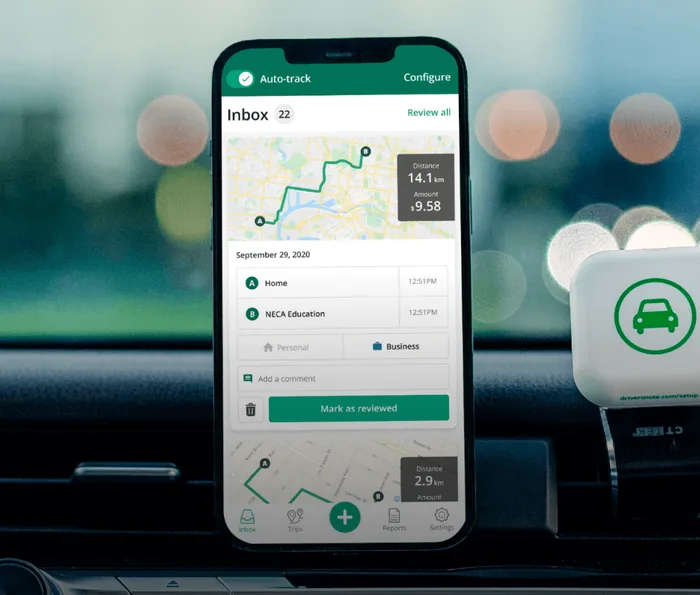
Automatic mileage tracking across your team gives you that record without asking support workers to manually log every trip, so travel time and vehicle costs are ready whenever you need to bill, pay or prove them.
Tired of logging mileage by hand?
Effortless. IRS-compliant. Liberating.
 Auto-track trips
 Classify trips
 IRS compliant reports