Latest update: 30 June 2026 - 5 min read
ATO Cents Per KM Rate 2026/2027
The 2026 ATO cents per kilometre rate for the 2026/2027 financial year is 91 cents per kilometre. The new rate applies from 1 July 2026. You can claim for up to 5,000 business kilometres per car each year, which means a maximum deduction of $4,550 if you reach the cap.
If you use your own car for work, this is the simplest way to claim a deduction. This guide covers the new rate, how the cents per kilometre method works, how much you can claim, and how the rate has changed over the years.
The ATO cents per km rate has increased for 2026/2027
For the income year starting 1 July 2026, the rate is 91c per kilometre. That is 3 cents up from 88c in 2025/2026.
| Tax year | ATO cents per km rate |
|---|---|
| 2026-27 | $0.91 per kilometre |
| 2025-26 | $0.88 per kilometre |
The 91c figure has two parts: a base rate of 89 cents plus a one-off uplift of 2 cents for this year only. The ATO added the uplift to account for higher than expected car running costs in 2026/2027, mainly driven by fuel price movements early in 2026.
The uplift is temporary. For future years, the ATO will apply its usual annual indexation to the base rate of 89 cents, not to the 91 cent figure.
You can read the details in the ATO’s Cents per Kilometre Deduction Rate determination (LI 2026/19).
How the cents per km method works
The cents per kilometre method lets you claim a set amount for every business kilometre you drive, without keeping receipts for your actual car costs. You multiply your business kilometres by the rate for the year.
What the rate covers
The rate is designed to cover all the running costs of your car, so you can’t claim these separately on top. That includes:
- Fuel and oil
- Registration and insurance
- Servicing, repairs and maintenance
- Depreciation (decline in value)
The 5,000 kilometre limit
You can claim a maximum of 5,000 business kilometres per car, per year, using this method. If you drive more than that for work, the extra kilometres aren’t deductible under this method. You can still use it, but your claim caps out at 5,000 km. Drivers who go well beyond 5,000 km often get a larger deduction with the logbook method instead.
What records you need to keep
You don’t need receipts to use this method, but you do need to show how you worked out your business kilometres. A reasonable estimate based on a regular pattern of travel is accepted, though a record of your trips is the safest approach.
A simple ATO-compliant vehicle logbook template or an automatic mileage tracking app makes this easy, and means your numbers hold up if the ATO ever asks.
How much can you claim in 2026/2027?
Your deduction is your business kilometres multiplied by 91 cents. Here are a few examples for the 2026/2027 year.
- 2,000 business km × $0.91 = $1,820
- 3,500 business km × $0.91 = $3,185
- 5,000 business km × $0.91 = $4,550 (the maximum)
So the most you can claim per car with the cents per kilometre method this year is $4,550. To work out your own figure quickly, try our cents per km calculator.
Cents per km vs the logbook method
The ATO gives you two ways to claim car expenses. You choose one method per car for the whole year.
The cents per kilometre method is relatively simpler. There’s no need to track every cost, and it suits people who drive moderate work distances. It caps at 5,000 km.
The logbook method has no kilometre cap and can produce a larger deduction if you drive a lot for work or have a high-cost car. It needs more record keeping: a 12-week logbook to set your business-use percentage, plus receipts for your running costs. See the full ATO logbook requirements before you choose.
Track your business kilometres automatically
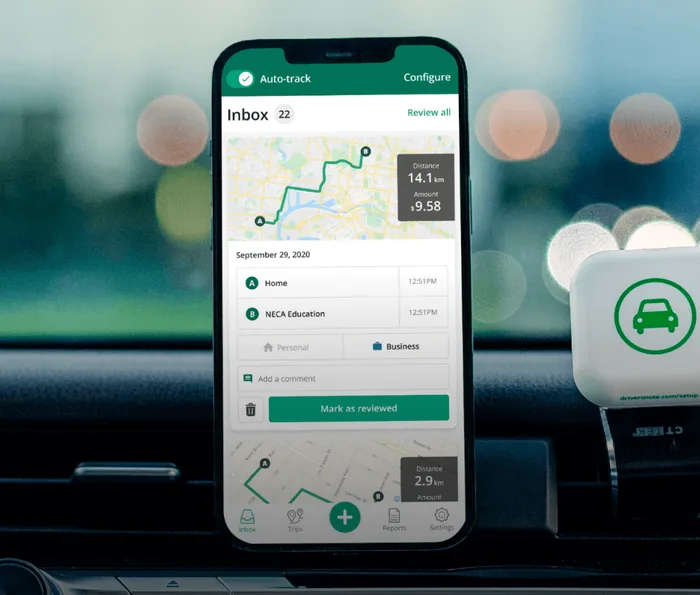
The cents per kilometre method only works in your favour if you actually capture your work trips. Driversnote vehicle logbook app logs your drives automatically and keeps an ATO-ready record, so when tax time comes your business kilometres and your deductions are ready to go.
Historic ATO cents per km rates
Here’s how the rate has changed over recent years. For the complete history back to 2008, see our page on historic ATO cents per km rates.
| Financial year | Cents per km rate |
| 2026-27 | 91 cents |
| 2025-26 | 88 cents |
| 2024-25 | 88 cents |
| 2023-24 | 85 cents |
*The 2026/2027 rate of 91 cents includes a one-off 2 cent uplift on top of the 89 cent base rate.
FAQ
The 91 cent rate applies to the 2026/2027 income year, which runs from 1 July 2026 to 30 June 2027. For trips before 1 July 2026, you use the 2025/2026 rate of 88 cents.
Sole traders and individuals who own or lease a car can use it, including self-employed people and employees claiming work-related car expenses. The car must be a motor vehicle designed to carry a load of less than one tonne and fewer than nine passengers. Companies and trusts can't use this method.
No, a formal 12-week logbook isn't required for this method. You only need a reasonable way to show how you calculated your business kilometres. Keeping a simple record of your work trips is the easiest way to support your claim.
Not with this method. The cents per kilometre method caps at 5,000 business kilometres per car each year. If you drive more than that for work, the logbook method has no cap and may give you a bigger deduction.
Tired of logging mileage by hand?
Effortless. IRS-compliant. Liberating.
 Auto-track trips
 Classify trips
 IRS compliant reports