Latest update: 10 March 2026 - 5 min read
The Logbook Method
The ATO logbook method lets you claim a percentage of your actual car expenses as a tax deduction, based on how much you use your vehicle for work. Unlike the cents per kilometre method, there’s no cap on the kilometres you can claim, which makes it the better option if you drive a lot for business or have high running costs.
To use this method, you need to keep a logbook for at least 12 continuous weeks. That logbook then determines your business-use percentage, which you apply to your total car expenses for the year.
If you wish to compare the advantages of both methods thoroughly, read the logbook vs cents per kilometre article.
Who should use the logbook method
The ATO logbook method is suitable for sole traders, partnerships, and employees. You can apply it if:
- You’re the sole proprietor of your business and are looking to claim deductions for the business-related use of your personal car.
- You’re in a partnership with two or more people and jointly operate the business and want to claim deductions for partnership use of your vehicle.
- You are an employee, and your employer didn’t reimburse you for your work-related vehicle expenses.
| If you own a company, trust, non-profit, cooperative, or LLP, you ARE NOT able to claim vehicle-based deductions with the logbook method. Read our article about mileage reimbursement for employers. |
What to include in a logbook
To comply with ATO logbook requirements, you need to keep records for at least 12 continuous weeks. Your logbook must include:
- The start and end dates of the logbook period
- Odometer readings at the beginning and end of the period
- The make, model, registration number, and engine capacity of the car
- The total kilometres driven during the period, split between business and personal use
- For each trip: the date, start and end odometer readings, kilometres travelled, and the reason for the journey
The ATO accepts electronic logbooks. You can use a dedicated mileage tracking app that records trips automatically and generates ATO-compliant reports.
Once completed, your logbook is valid for 5 years, provided your driving patterns remain broadly the same. You’ll still need to record odometer readings at the start and end of each subsequent income year you rely on it.
Car expenses deductible with the logbook method
According to the ATO, you can claim the business-use percentage of the following running costs:
| Deductible expense | Notes |
| Fuel and oil | Actual receipts or a reasonable estimate based on odometer records |
| Servicing and repairs | Keep receipts |
| Registration | Include the full annual cost |
| Insurance | Keep receipts |
| Interest on a car loan | If you financed the vehicle |
| Depreciation (decline in value) | Logbook method only - see below |
What you cannot claim: the purchase price of the car, loan principal repayments, or any improvement costs. These are capital costs, not running expenses.
Calculating your claim
To work out your deduction, you need two figures: your business-use percentage and your total car expenses for the year.
Step 1: Calculate your business-use percentage
Divide your business kilometres by your total kilometres during the logbook period, then multiply by 100.
Example:
- Total km driven: 6,000
- Business km: 2,000
- Business-use percentage: (2,000 / 6,000) x 100 = 33.33%
Step 2: Apply the percentage to your total expenses
Multiply your total car expenses for the income year by your business-use percentage.
Example:
- Total car expenses: $5,000
- Deductible amount: $5,000 x 33.33% = $1,666.67
There’s no upper limit on what you can claim under the logbook method, unlike the cents per kilometre method, which caps claims at 5,000 km per year.
How to claim depreciation using the logbook method
The logbook method also lets you claim depreciation (decline in value) on your car, but only if you own the vehicle or hold it under a hire-purchase agreement. Depreciation is not available under the cents per kilometre method.
There are two ways to calculate it.
Depreciation methods: straight-line vs. diminishing value
| Method | How it works | Best for |
| Straight-line (prime cost) | Equal deduction each year | Lower-cost vehicles with a longer useful year |
| Dimishing value | Higher deductiobs in early years, reducing over time | More expensive vehicles that lose value quickly |
The ATO sets the effective life of most cars at 8 years, giving a diminishing value rate of 25% and a prime cost rate of 12.5%.
Calculating depreciation using the diminishing value method
This is the more common approach, since it front-loads the deduction in the years when your car is losing the most value. Here’s how it works using a $25,000 car at 70% business use:
Year 1
- Opening value: $25,000
- Depreciation (25%): $6,250
- Business-use portion (70%): $4,375 claimable
Year 2
- Opening value: $25,000 - $6,250 = $18,750
- Depreciation (25%): $4,688
- Business-use portion (70%): $3,281 claimable
Year 3
- Opening value: $18,750 - $4,688 = $14,063
- Depreciation (25%): $3,516
- Business-use portion (70%): $2,461 claimable
The deductible amount decreases each year as the car’s value reduces. Note that the ATO applies a car cost limit for depreciation - for 2025/26, this is $69,674. If your car costs more than this, you can only use the limit amount when calculating depreciation.
FAQ
Your logbook is valid for 5 years from the income year it was completed, provided your driving habits remain broadly the same. If you change jobs, move house, or your business activities shift significantly, you'll need to complete a new 12-week logbook.
If your circumstances change in a way that makes your existing logbook unrepresentative of your actual business driving, you need to keep a new logbook. Examples include changing jobs, moving to a different work location, or taking on a new type of work.
You'll need your logbook, odometer records for the start and end of each income year you're claiming, and written evidence (receipts) for all car expenses except fuel (where an estimate based on odometer readings is acceptable). The ATO requires these records to be kept for 5 years from the date you lodge your tax return.
The logbook method has no kilometre cap, so it's more valuable for high-mileage drivers. It also lets you claim the actual cost of running your car, including depreciation and interest on a car loan, rather than a fixed rate. If your business-use percentage is high and your running costs are significant, the logbook method will typically produce a larger deduction.
Keep a logbook for 12 continuous weeks to establish your business-use percentage. Then, at tax time, add up all your car expenses for the year and multiply by that percentage. That's your deductible amount.
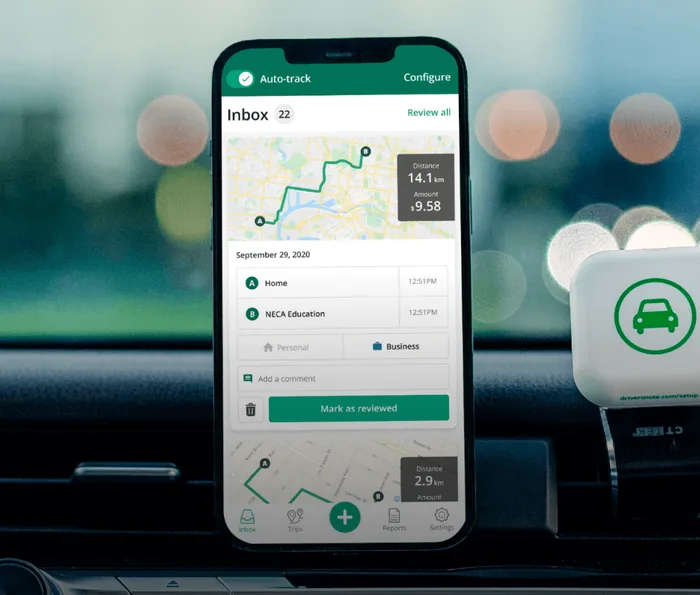
Tired of logging mileage by hand?
Effortless. IRS-compliant. Liberating.
 Auto-track trips
 Classify trips
 IRS compliant reports