
Latest update: 21 October 2026 - 5 min read
What Vehicle Expenses Can You Claim?
It depends on how you work, what you drive, and who owns the vehicle. Answer a few questions below and find out whether you can claim, which ATO method you’re allowed to use, which of your trips count, and exactly which costs go on your return.
Most people get stuck in the same place: they know motor vehicle expenses are deductible, but not which of the three ATO methods they’re actually allowed to use, or whether the driving they do counts in the first place. Those two questions decide the whole claim, and the answers change completely between a sole trader in a hatchback and a director in a company ute.
Rather than explain all four structures at once, work through your own situation with our handy tool.
Check which vehicle expenses you can claim
- Cents per km rate
- 91c
- Annual cap
- 5,000 km
- Logbook period
- 12 weeks
- Keep records
- 5 years
Which method you’re allowed to use
This is the part people get wrong most often, and it isn’t a choice you get to make freely. Your business structure and your vehicle type decide it between them.
| Structure | Car | Other vehicle |
|---|---|---|
| Sole trader | Cents per km or logbook | Actual costs |
| Partnership | Cents per km or logbook | Actual costs |
| Company | Actual costs only | Actual costs only |
| Trust | Actual costs only | Actual costs only |
| Employee | Cents per km or logbook | Actual costs |
Two things in that table surprise people. Companies and trusts can’t use cents per kilometre at all, no matter what they drive. And “other vehicle” is a bigger category than it sounds.
What counts as a car
The ATO calls it a car only if it carries less than one tonne and fewer than nine passengers. Electric and hybrid vehicles are included. Motorcycles are not.
So a one-tonne ute, a van rated above that, or a nine-seat minibus isn’t a car under these rules, and the two shortcut methods are off the table. You claim the business portion of actual running costs instead, with receipts. If you’re buying one, it’s worth reading about writing off a vehicle for your business before you commit.
Which trips count as claimable expenses
The second half of the claim. A deductible method is no use if none of your driving qualifies.
| Trip | Claimable? | Why |
|---|---|---|
| Home to your regular workplace | No | Getting to work puts you in a position to work. Private. |
| Between two workplaces, same day | Yes | As long as neither end is your home. |
| To a client site or training venue | Yes | Somewhere you work but don’t normally work. |
| Home to work with bulky tools | Sometimes | Four conditions, all of which must hold. |
| No fixed workplace, moving all day | Yes | Itinerant work. |
| From home, where home is your business base | Yes | Business trips only. Private legs still aren’t. |
| Called in while on standby | No | Still travel to start work. Private, even at 3am. |
Working from home doesn’t change your commute
Doing part of your job at home, even most of it, doesn’t make the drive into the office deductible. The ATO’s position is that you’re still travelling in order to start work rather than in the course of doing it.
What does change things is if your home is genuinely the base of your business, not just somewhere you also work. Then trips from home to customers are claimable.
There’s more on the boundary in our guide to working from home deductions.
The four conditions for claiming travel with bulky tools
You can claim home-to-work travel when you’re carrying tools, but only if all four of these hold: the items are essential to the job, they’re genuinely bulky and awkward to move, there’s no secure storage at the workplace, and carrying them isn’t simply your preference.
Fail any one and the trip is an ordinary commute. If you’re relying on this, document what you carry, its size and weight, and why it can’t be left on site.
Which motor vehicle expenses each method covers
Cents per kilometre
A single rate of 91c covers every running cost of the car — fuel, servicing, tyres, registration, insurance, loan interest, lease payments and depreciation. You can’t claim any of them separately on top. Capped at 5,000 business kilometres per car per year.
Business parking and tolls sit outside the rate and are claimed in addition. Our cents per km calculator will do the math for you.
Logbook method
You establish your business-use percentage with a 12-week logbook, then claim that share of every actual running cost. No kilometre cap, and once the logbook is done it stays valid for five years.
Above roughly 5,000 business kilometres, or on an expensive car, this almost always claims more. Worth comparing properly: logbook vs cents per km.
Actual costs
The business portion of what it genuinely costs to run the vehicle, with receipts for everything. No shortcut rate, and the strictest record-keeping of the three. This is the only option for companies, trusts, and anyone whose vehicle isn’t a car.
What records do you need?
It depends on the method, but the five-year rule (keep everything for five years after you lodge) applies to all of them.
- Cents per km: a record of your business kilometres with dates and reasons, and evidence you own or lease the vehicle.
- Logbook: 12 continuous weeks of entries, odometer readings at each end and each income year, plus receipts for the running costs you’re claiming.
- Actual costs: receipts or tax invoices for every expense, and a defensible record of the business-private split.
The logbook rules are specific about what each entry must contain. Check yours against the ATO’s logbook requirements, or start from an ATO-compliant template.
FAQs
Can a company claim cents per kilometre?
No. The cents per kilometre method is only available to sole traders and partnerships where at least one partner is an individual, and to employees claiming work-related car expenses. A company or trust uses actual costs regardless of what it owns.
Can I claim expenses if I get car allowance?
An allowance is income, not a reimbursement. You declare it, and then you claim your actual work-related driving separately using one of the methods above. The two aren’t connected, and receiving an allowance doesn’t by itself entitle you to a deduction. More on how this works in car allowances for employees.
Can I claim expenses if I drive a company car?
Not the running costs, no. Those belong to whoever owns the vehicle, and private use is handled through fringe benefits tax rather than your return. You can still claim out-of-pocket costs you paid yourself and weren’t reimbursed for, like business parking.
How much can I claim without receipts?
Less than people hope. The cents per kilometre method doesn’t require receipts for individual running costs, but you still need a record of the kilometres and why each trip was for work. There’s no version of this where you claim 5,000 kilometres with nothing to show. Here’s what you can and can’t claim without receipts.
Is this the same as a vehicle tax write-off?
No, and the two get mixed up constantly. A write-off is about the vehicle itself — deducting the cost of buying it, through depreciation or the instant asset write-off. This page is about the running costs: fuel, servicing, insurance, registration and the rest, claimed each year through one of the three ATO methods.
Most people who buy a vehicle for work end up doing both. If you’re looking at the purchase side, start with writing off a vehicle for your business.
Is the app I track with deductible too?
Usually, and it’s claimed separately from the vehicle expenses rather than being absorbed by a per-kilometre rate. The answer changes depending on who pays for it and whether you’ve got work-related driving at all — the full version is in is your logbook app tax deductible?
FAQ
No. The cents per kilometre method is only available to sole traders and partnerships where at least one partner is an individual, and to employees claiming work-related car expenses. A company or trust uses actual costs regardless of what it owns.
An allowance is income, not a reimbursement. You declare it, and then you claim your actual work-related driving separately using one of the methods above. The two aren't connected, and receiving an allowance doesn't by itself entitle you to a deduction. More on how this works in car allowances for employees.
Not the running costs, no. Those belong to whoever owns the vehicle, and private use is handled through fringe benefits tax rather than your return. You can still claim out-of-pocket costs you paid yourself and weren't reimbursed for, like business parking.
Less than people hope. The cents per kilometre method doesn't require receipts for individual running costs, but you still need a record of the kilometres and why each trip was for work. There's no version of this where you claim 5,000 kilometres with nothing to show. Here's what you can and can't claim without receipts.
No, and the two get mixed up constantly. A write-off is about the vehicle itself — deducting the cost of buying it, through depreciation or the instant asset write-off. This page is about the running costs: fuel, servicing, insurance, registration and the rest, claimed each year through one of the three ATO methods. Most people who buy a vehicle for work end up doing both. If you're looking at the purchase side, start with writing off a vehicle for your business.
Usually, and it's claimed separately from the vehicle expenses rather than being absorbed by a per-kilometre rate. The answer changes depending on who pays for it and whether you've got work-related driving at all — the full version is in is your logbook app tax deductible?
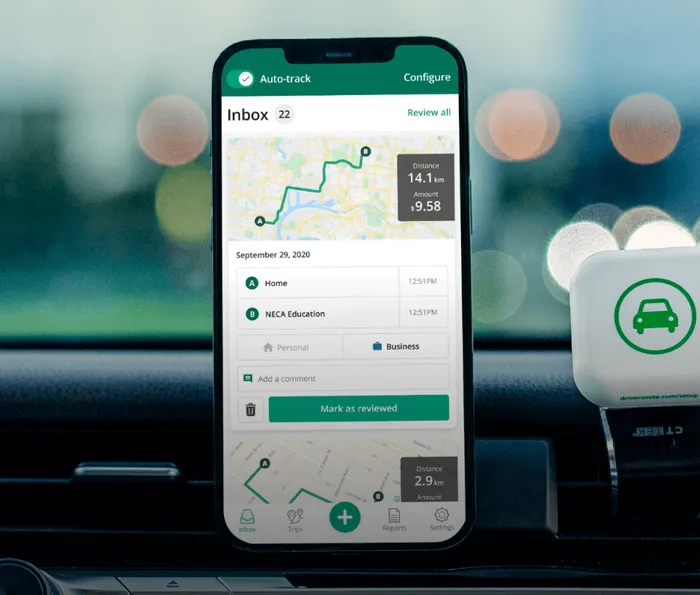
Tired of logging mileage by hand?
Effortless. IRS-compliant. Liberating.
 Auto-track trips
 Classify trips
 IRS compliant reports