
Latest update: 20 July 2026 - 5 min read
Writing Off a Car For Business in Australia
If you drive for work-related purposes, whether it’s visiting client sites, attending conferences, or heading to business meetings, you may qualify for a business tax write-off on your car.
It’s one of many company car tax benefits; you can read our other guide for more benefits or items you could write off.
| Key figures: Car limit (2026/27): $69,883 | Instant asset write-off threshold (2026/27): $20,000 | Cents per km rate: 91c/km for 2026/27 (up to 5,000 km) | Max GST credit on vehicle purchase: $6,353 |
Vehicle expenses you can write off
The business usage component of your company car can be claimed as a tax deduction. This includes:
- The purchase price (up to the ATO car limit)
- Interest on borrowing
- Fuel
- Insurance
- Maintenance and repairs
- Registration
You can only claim the portion of these expenses that relates to business use. If you use the car for personal trips too, you’ll need to work out the business-use percentage, which is where a vehicle logbook comes in.
It’s also worth noting that this applies to company car tax benefits more broadly. There are other items you may be able to write off beyond what’s covered here.
ATO limit on the car price you can claim
When buying a car for a business tax write-off, the ATO sets a maximum claimable amount called the car limit. For the 2026/27 financial year, this is $69,883.
The car limit is applied before accounting for your business usage percentage.
Example: If you purchased a car for $80,000 and your logbook showed 90% business use, the maximum you can claim is 90% of $69,883, which works out to $62,894.70. You can’t claim the remaining amount under any other depreciation rules.
GST credit on your vehicle purchase
If you’re registered for GST, you can also claim a GST credit on the business portion of your car purchase. The maximum GST credit is capped at $6,353 for 2026/27 (one-eleventh of the car limit), regardless of what you paid for the vehicle.
See the section below for how to work out your business vs personal usage split on all your driving.
How to claim the write-off
You can either depreciate the car over several years or claim it as a one-off cost in the year of purchase. To claim as a one-off, the asset must meet the Small Business Entity (SBE) instant asset write-off rules.
Eligibility depends on:
- The annual turnover of your business
- The purchase date of the asset
- The date it was first used or installed ready for use
- The cost being below the relevant threshold
Instant asset write-off limit
The $20,000 instant asset write-off has been extended to 30 June 2027 and is now law. Businesses with an aggregated turnover of less than $10 million can immediately deduct the full cost of eligible assets under $20,000 that are first used or installed ready for use between 1 July 2023 and 30 June 2027.
The limit applies per asset, so you can write off multiple eligible assets in the same year.
Important: Most passenger cars cost more than $20,000, which means they won’t qualify for instant write-off. In that case, you add the vehicle to your small business pool and depreciate it at 15% in the first year and 30% each year after. You can find the full instant asset write-off eligibility rules on the ATO website.
Also read: Claim Motor Vehicle Depreciation from the ATO
Choose the right method for your business-related driving deduction
There are two ATO-approved methods for claiming car expenses as a tax deduction. You can’t combine them in the same financial year, but you can choose whichever gives you the biggest benefit.
Companies, trusts and non-car vehicles can only claim actual costs. Our vehicle expense checker shows which method applies to you.
| Cents per km method | Logbook method | |
| Rate / basis | 91c per km (2026/27) | Actual expenses × business-use % |
| Max claim | 5,000 km = $4,400 | No cap |
| Records needed | Recommended, not mandatory | 12-week logbook + all receipts |
| Depreciation included? | Yes, built into the rate | Yes, claimed separately |
| Best for | Lower mileage, simpler situations | High mileage or expensive vehicles |
If you’re buying a car specifically for business use, the logbook method will usually give you a larger deduction, especially if the car is used heavily for work. But it does require more record-keeping.
| For a more comprehensive comparison of the two, read: The Logbook Method vs The Cents per KM Method |
If your company car is used for personal purposes, you also need to consider the impact of Fringe Benefits Tax (FBT) on your purchase.
You should speak with a registered tax professional about your individual circumstances to help you determine the best way to proceed.
Work out the business usage with a digital vehicle logbook
If you use your car for both business and personal trips, you need to establish the business-use percentage before you can calculate your deduction. The ATO requires you to keep a logbook for a continuous 12-week period that reflects your typical driving pattern.
How the business-use percentage works
Your business-use percentage is the share of your total kilometres driven for work purposes. Here’s how to calculate it:
- Track every trip for 12 continuous weeks, noting the date, destination, purpose, and kilometres
- Add up your business kilometres (client visits, site inspections, travel between work locations)
- Divide by your total kilometres driven in that period
- Apply the percentage to your actual car expenses to get your claimable deduction
Example: You drove 4,000 km over 12 weeks. 2,800 km were for business. Your business-use percentage is 70%. If your total car expenses for the year were $12,000, you can claim $8,400.
One important exclusion: commuting from home to your regular place of work does not count as business use under ATO rules, even if you drive every day.
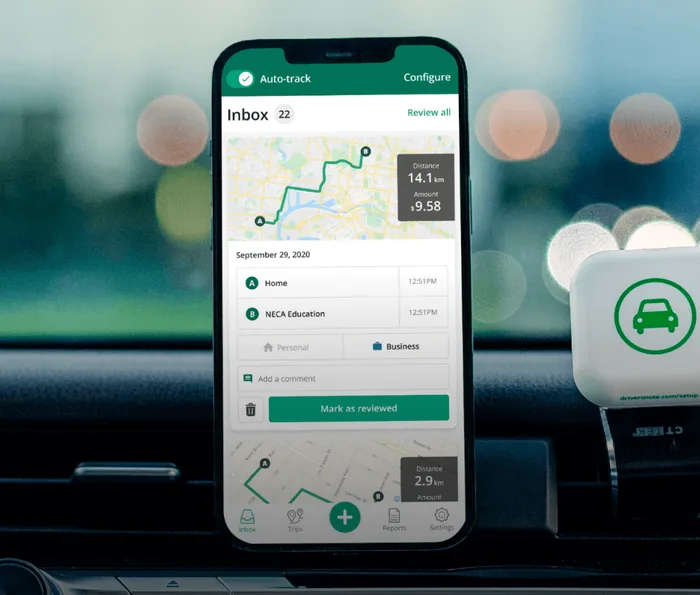
A digital vehicle logbook like Driversnote makes this straightforward. The app tracks trips automatically and lets you classify each one as business or personal with a tap. At the end of the selected period, it calculates your business-use percentage and generates an ATO-compliant report you can hand straight to your accountant.
Once you’ve established your logbook, it’s valid for five years, as long as your driving patterns don’t change significantly.
FAQ
Yes. You can write off the business-use portion of a car purchase as long as it doesn't exceed the ATO car limit ($69,883 for 2026/27). You'll need records to support your business-use percentage.
If the car costs less than the car limit and is used exclusively for business, you can write off the full amount. If it costs more, you can only claim up to $69,883 (the 2026/27 limit), and only the business-use portion of that.
The limit is $20,000. The extension to 30 June 2027 is now law, applying to businesses with an aggregated turnover under $10 million. Most passenger cars exceed this threshold, so they'll typically go into the small business depreciation pool instead.
The maximum GST credit is $6,353 for 2026/27 (one-eleventh of the $69,883 car limit), regardless of what you paid for the vehicle.
It's only if you're using the logbook method. For the cents per km method, a logbook is recommended but not mandatory. For most people buying a car for business use, the logbook method will result in a higher deduction.
Tired of logging mileage by hand?
Effortless. IRS-compliant. Liberating.
 Auto-track trips
 Classify trips
 IRS compliant reports