Latest update: 23 April 2026 - 15 min read
Grey Fleet Vehicles vs. Company Cars: What’s the Best Option for Your Organisation?
For most Australian organisations, the choice comes down to two things: how many business kilometres your team drives, and what type of vehicle makes sense.
- Lower annual kilometres → a grey fleet is usually cheaper and simpler
- Higher annual kilometres → company cars often become more cost-efficient
This article breaks down the costs, tax implications, and non-financial trade-offs, so you can pick the setup that fits your business.
The two models explained
Company cars. The employer leases or purchases the vehicles directly and covers insurance, servicing, registration, and maintenance. If the car is available for private use, the employer may also be liable for Fringe Benefits Tax (FBT).
A grey fleet. Employees use their own vehicles for business travel, and you reimburse them per kilometre. You avoid vehicle ownership costs, but you take on compliance obligations around recordkeeping, insurance, and the duty of care.
Grey fleets are potentially simpler to run day-to-day, but give you less direct control over vehicle safety, age, and consistency across the team.
Both models are common in Australia - and so is mixing them up. The right fit for your company depends on team size, how much employees drive for work, and how much fleet management you want to take on.
Which model suits which organisation?
| Scenario | Better fit |
| Lower business kilometres (under ~15,000 km/year) | A grey fleet (cents-per-km) |
| High business kilometres (15,000+ km/year) | Company car |
| Small or distributed team | A grey fleet |
| Brand visibility or specific vehicle standards matter | Company car |
| Workforce prefers flexibility | A grey fleet |
Costs for grey fleets
The biggest financial advantage of a grey fleet is what isn’t on the employer’s books. You don’t buy or lease the vehicles, you don’t pay for insurance, servicing, registration, or depreciation, and you don’t carry fixed costs for cars that sit idle.
The employee owns the vehicle and absorbs the running costs.
What you do pay for is the business use itself — usually through a cents-per-km reimbursement, or less often through a car allowance.
Cents-per-kilometre reimbursement
Employers commonly reimburse employees at the ATO cents-per-km rate — 91 cents per kilometre for 2026–27.
Reimbursements at or below this rate, paid for actual business travel, are generally treated as tax-free reimbursements of expenses for the employee.
The rate is designed to cover all vehicle running costs: fuel, wear and tear, insurance, registration, and depreciation.
For employers, the benefit is simplicity — costs scale directly with actual business use, with no fixed commitment per employee.
There’s no kilometre cap on employer reimbursement. The 5,000 km cap applies only when an employee claims a personal tax deduction using the cents-per-km method at tax time. Those are two separate things.
Tracking kilometres under the per-km rate
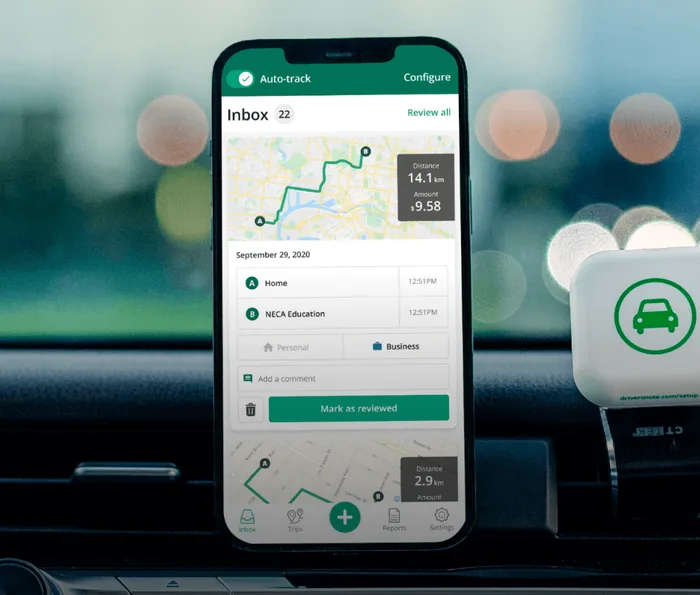
The cents-per-km reimbursement is tax-free, but only when you can show the ATO that claims are accurate and tied to genuine business travel. Manual logs and spreadsheets create predictable gaps — rounded distances, reconstructed trips, late submissions — which quietly weaken the tax position and inflate what you pay.
Automated kilometre tracking removes most of that risk. Trips are recorded as they happen, records are stored digitally, and finance teams get consistent data instead of chasing employees at payroll time.
Car allowance
A car allowance is a fixed regular payment, typically added to salary monthly, that helps the employee fund their own vehicle. It’s fully taxable as income.
It can be combined with cents-per-km reimbursement, but this combination is the most expensive option for employers — you pay a fixed salary top-up and per-kilometre costs.
| ### Key distinction: a car allowance is not a substitute for per-km reimbursement. If you pay an allowance but no per-km reimbursement, employees can still claim work-related vehicle expenses as a personal tax deduction at tax time. |
Costs: company cars
Fixed vehicle costs
When you provide a company car, you absorb the lease or purchase cost, insurance, servicing, tyres, and registration. Those costs are fixed, regardless of how many kilometres the car actually does — an idle car still costs you roughly $500–$800 a month in lease and running costs, depending on the vehicle.
Business fuel reimbursement
For business journeys in company cars, most Australian employers either pay fuel costs directly or issue a fuel card.
There’s no ATO-published advisory fuel rate in Australia, so employers typically use actual fuel costs or estimate a per-km fuel rate based on the vehicle’s consumption.
The ATO does publish a cents-per-km rate for FBT purposes when you’re reimbursing employees for business use of a company car, and it aligns with the standard 91c/km rate.
Also read: Company vehicle policy
Real-world cost comparison
The table below walks through three scenarios for the same employee, showing how the numbers move. All figures represent employer cost only.
- Employee profile: field consultant, 18,000 business kilometres per year, mid-size petrol car.
- Note on the 5,000 km cap: these examples use 18,000 business km. That’s valid for employer reimbursement.
- The 5,000 km cap only applies when an employee claims a personal tax deduction — it doesn’t limit what an employer can reimburse.
Scenario 1: Grey fleet, cents-per-km only
| Component | Calculation | Annual cost |
| Km reimbursement | 18,000 × $0.91 | $16,380 |
| Vehicle, insurance, maintenance | Covered by employee | $0 |
| Total employer cost | $16,380 |
Scenario 2: Grey fleet, car allowance + cents-per-km
Adding a car allowance increases total cost without reducing per-km spend.
| Component | Calculation | Annual cost |
| Car allowance | $600 × 12 | $7,200 |
| Km reimbursement | Same as above | $16,380 |
| Total employer cost | $23,580 |
In practice, this combination is often the most expensive setup for employers.
Scenario 3: Company car (petrol, leased)
With a company car, costs are more fixed, regardless of how much the vehicle is used.
| Component | Calculation | Annual cost |
| Vehicle lease | $700 × 12 | $8,400 |
| Insurance and maintenance | Fixed | $2,400 |
| Business fuel | 18,000 × $0.18 (approx. 9 L/100 km at $2/L) | $3,240 |
| Total employer cost | $14,040 |
FBT isn’t included here — see the tax section below.
At around 18,000 km a year, a company car can come out cheaper on direct costs than reimbursing at the ATO rate. At lower annual distances, a grey fleet typically remains more cost-effective. As kilometres rise, the fixed-cost nature of a company car starts to work in your favour.
The exact crossover point varies with lease costs, fuel prices, and vehicle type — but for many organisations, it sits somewhere between 15,000 and 20,000 km a year.
Note: these figures are illustrative. Actual costs vary by vehicle, lease terms, location, and employee driving patterns.
Why the comparison matters
The fundamental difference comes down to how costs behave:
- A grey fleet is a variable cost that scales with each kilometre driven
- A company car is a fixed cost that becomes more efficient with higher usage
- That’s why many organisations end up running a hybrid — reimbursing occasional drivers through a grey fleet, while providing company cars for high-driving roles.
Tax implications compared
Company cars and FBT
If a company car is available for private use, the employer is liable for Fringe Benefits Tax (FBT). The current FBT rate is 47%, applied to the taxable value of the car benefit. FBT is calculated using one of two methods:
- Statutory formula method: 20% of the car’s base value, adjusted for days available and any employee contributions
- Operating cost method: actual running costs multiplied by the private-use percentage, based on a valid logbook
| ### Key point: FBT applies based on availability for private use, not just actual kilometres driven. A car that’s nominally business-only but lacks documented restrictions will still trigger FBT. |
One thing worth knowing: FBT is the employer’s liability by default, but the employee contribution method lets the employee pay an after-tax contribution toward the car’s running costs.
That contribution reduces the taxable value of the benefit, and with it the FBT bill. It’s a common way to share or effectively shift part of the FBT cost to the employee in a compliant way — usually set out in the employment contract or a salary packaging arrangement.
A grey fleet: cents-per-km and tax efficiency
When trip records are accurate, and business journeys are clearly documented, cents-per-km reimbursements are tax-free for both employer and employee, and there’s no FBT on a personal vehicle.
Key risk: if the ATO challenges reimbursement claims as inaccurate or misclassified, reimbursements may be reclassified as taxable income, triggering PAYG obligations and potential penalties. Automated kilometre tracking reduces that risk by creating a contemporaneous, auditable record.
Car allowance
Treated as income by the ATO — subject to income tax and PAYG withholding regardless of how the car is actually used. No vehicle logbook is required for the allowance itself, but it provides no tax efficiency for either party. See the car allowance guide for employers for a full breakdown.
Quick comparison
| A grey fleet (cents-per-km) | Company car | Car allowance | |
| Employer tax liability | None if within the ATO rate | FBT at 47% on private-use value | None (employee pays income tax) |
| Employee tax liability | None | None by default — but employees can make after-tax contributions to reduce FBT | Income tax on the allowance |
| Records required | Trip logs | Logbook for operating cost method | Not required for the allowance itself |
So which option should you choose?
Cost is a loud factor, but it’s not the only one. Once the financial picture is clear, most decisions also turn on people, brand, and risk:
- Kilometre profile. Under ~15,000 km/year, a grey fleet with cents-per-km reimbursement is usually the simplest and most cost-effective option. At higher annual distances, company cars become more cost-efficient because fixed costs get spread across more kilometres.
- Fleet safety and duty of care. Company cars give you direct control over vehicle age, safety ratings, and servicing. A grey fleet can include a much wider mix of vehicle ages and conditions, which can affect risk.
- Attraction and retention. For some roles, a company car is a meaningful perk. For others, a grey fleet arrangement with a clear reimbursement process gives employees more flexibility in the vehicle they actually want to drive.
- Brand and presentation. If employees visit client sites or represent the business visibly, company cars offer consistency in how your brand shows up. A grey fleet leaves that to individual choice.
- Admin capacity. Company cars come with ongoing fleet management — procurement, servicing and FBT.
Most organisations end up running a mix — company cars for high-driving roles, and a grey fleet for everyone else. The decision is worth revisiting every couple of years as kilometres, vehicle prices, and tax settings change.
FAQ
Yes. Many organisations offer employees a choice between a company car and a cash allowance that funds grey fleet use. The tax treatment differs significantly between the two, so employees should understand the implications before choosing. See our car allowance vs company car guide for a full comparison.
It depends on usage. A grey fleet is usually cheaper at lower kilometres, while company cars tend to become more cost-effective at higher annual distances — particularly for eligible EVs, where the FBT exemption materially lowers the total cost.
A grey fleet is when employees use their own vehicles for work and are reimbursed for business travel, usually via a cents-per-km rate.
No. FBT applies when the car is available for private use, but some vehicles — including eligible EVs under the LCT threshold, and certain utes and vans — can be exempt.
A cents-per-km reimbursement tied to actual business travel is generally tax-free when paid at or below the ATO rate (91c/km for 2026–27). Car allowances are always taxable as income, regardless of how the car is used.
Yes. Under the employee contribution method, employees can make after-tax contributions toward the car’s running costs, which reduce the taxable value of the benefit and therefore the FBT payable. The arrangement is usually set out in the employment contract or a salary packaging agreement.
Tired of logging mileage by hand?
Effortless. IRS-compliant. Liberating.
 Auto-track trips
 Classify trips
 IRS compliant reports