Latest update: 23 April 2026 - 10 min read
ATO Compliance for Your Grey Fleet
When employees use their own cars for work, the ATO has clear expectations around records, reimbursements, and tax treatment. Most businesses aren’t across all of it — especially when they’re managing a mix of company-owned and employee-owned vehicles, where the rules shift depending on who holds the keys.
This guide covers the tax and recordkeeping obligations that apply when employees drive for work in Australia.
It’s written for finance teams, payroll officers, bookkeepers, CFOs, and business owners managing reimbursements and FBT.
Note: This guide focuses on ATO rules and reimbursement. For the safety and duty-of-care side of grey fleet management, see our grey fleet risk assessment guide.
ATO vehicle logbook requirements
When employees use their own vehicles for work and you reimburse them, records do the heavy lifting.
The exact tax treatment depends on how you pay employees for business travel. The three most common setups are:
- Cents per kilometre reimbursement - paid after the employee records actual business trips
- Actual expenses reimbursement - the employer covers documented running costs
- Car allowance - a fixed amount paid regularly through payroll as part of salary
These aren’t interchangeable. Mixing them up in payroll is one of the most common mistakes, and it usually creates issues for both the business and the employee.
A cents-per-km reimbursement tied to actual business kilometres is generally treated as a reimbursement of expenses — not taxable income — when paid at or below the ATO rate. A car allowance paid as a fixed amount is taxable income, regardless of how it’s used.
The ATO cents-per-km rate for 2025–26
The ATO publishes a cents-per-km rate each year. For 2026–27, that rate is 91 cents per kilometre.
A few things to know about this rate:
- It’s the rate individuals (employees, sole traders, partnerships) can use to claim a deduction on their own tax return under the cents-per-kilometre method, capped at 5,000 business km per car per income year.
- It’s also the benchmark most employers use when setting a reimbursement rate, because reimbursements paid at or below it — against actual km records — are generally tax-free for the employee.
- Reimbursing above the ATO rate is allowed, but the excess is usually treated as taxable income.
- The rate covers all running costs: fuel, maintenance, insurance, registration, and depreciation.
- The rate is advisory for employers, not mandatory. You can reimburse at a lower rate — employees can then claim any shortfall as a deduction at tax time.
What employees need to record
Employees should keep accurate, trip-level records for all work-related travel. Per the ATO’s logbook requirements, a compliant record should capture:
- The date of the trip
- The start and end location
- The reason for the journey
- The total distance travelled
- Whether the trip was business or private
If an employee is claiming car expenses personally using the logbook method, the bar is higher: a valid logbook must cover at least 12 continuous weeks, include odometer readings at the start and end of each trip, calculate a business-use percentage, and record every trip — not just work ones. That logbook is valid for up to 5 years, provided the employee’s driving patterns don’t change significantly. Additionally, they must keep all receipts of car expenses.
What employers need to keep
From the employer’s perspective, logbook records are evidence. To support any reimbursement or allowance, you should be able to show:
- Why the payment was made
- How the amount was calculated
- Which work-related trips it covered
- That the same standards applied consistently across the team
In practice, that means keeping employee trip logs, reimbursement records, payroll documentation, and the policy documents that set out how your business handles work-related driving.
How long should records be kept? As a baseline, tax records in Australia should be kept for 5 years from the date of lodgement. Care sector employers should note that record-keeping obligations can run longer: our NDIS & Care Provider Guide covers Fair Work’s seven-year requirement for employee records, which stacks on top of the ATO’s five years for logbooks.
Vehicle ownership: what changes for tax and compliance
Not all work-related driving is treated the same way. The tax and compliance position shifts depending on who owns the vehicle and how it’s used.
1. Employee-owned vehicles (the grey fleet)
This is the standard grey fleet scenario. The employee uses their own car for work, and the employer reimburses them, pays a car allowance, or lets them claim a deduction at tax time.
Documentation is the main safeguard here. Because the employer doesn’t control the vehicle, the records must show that the payment was tied to genuine business travel. Employees should be able to demonstrate:
- Which trips were for work, and which were private or ordinary commuting
- The date, route, distance, and purpose of each journey
- That the business-use pattern is supported by consistent records
A rule that applies regardless of setup: travel between home and a regular workplace is private travel (commuting), not business travel. The exception is when the journey itself is part of the job — travelling to client sites, between work locations, or where there’s no fixed workplace.
2. Employee-leased vehicles
If the lease is in the employee’s name, the vehicle is treated much like an employee-owned car for tax purposes. The same practical points apply: business and private use must be clearly separated, and any reimbursement must be supported by accurate trip records. A lease in the employee’s name doesn’t make the vehicle a company car.
3. Company-owned or employer-leased vehicles
When the business provides the vehicle, the rules shift.
In Australia, private use of a company car can trigger Fringe Benefits Tax (FBT). FBT applies when the car is made available for private use — not just when the employee actively uses it that way. The current FBT rate is 47%, and the liability sits with the employer.
FBT on a car benefit can be calculated in one of two ways:
| Method | How it works |
| Statutory formula | 20% of the car’s base value, adjusted for days available and any employee contributions |
| Operating cost method | Actual running costs multiplied by the private-use percentage, based on a valid logbook |
Accurate vehicle records help you apply the right method, support FBT reporting, and keep the audit trail clean. They also let you reconcile fuel costs and allocate travel expenses across teams, sites, or clients.
When FBT may not apply
Some vehicles and situations are exempt. Cars that may be exempt from FBT include:
- Single-cab utes
- Dual-cab utes or 4WDs designed to carry more than 1 tonne or more than 8 passengers
- Panel vans and goods vans
- Certain modified vehicles (such as hearses)
- Eligible electric vehicles first held and used on or after 1 July 2022, priced below the Luxury Car Tax threshold for fuel-efficient vehicles ($91,387 for 2025–26)
There’s also a limited private use exemption for any vehicle, but the conditions are narrow: private travel must not exceed 1,000 km per FBT year, no single trip can exceed 200 km return, and the employer must have a written policy in place restricting private use to work-related travel and minor, infrequent, irregular use.
If private use is prohibited, records still matter. A policy on its own isn’t enough if the business can’t show how vehicle use was actually monitored.
Also read: Car allowance vs. company cars - which is best for your business?
The risks of poor recordkeeping
Weak documentation creates tax risk, payroll friction, and admin drag at the same time.
Reimbursements become harder to defend
If the business can’t clearly show what a payment relates to, justifying the tax treatment gets harder. The ATO may decide that reimbursements don’t qualify for tax-free treatment if the underlying records are incomplete, inconsistent, or created long after the travel happened.
Common red flags:
- Rounded or estimated distances
- Missing trip purposes
- No clear separation of business and private travel
- Records submitted weeks after the fact
- Car allowance and cents-per-km reimbursement treated as the same thing in payroll
Car allowance reporting errors
Car allowances are taxable income and must be reported correctly through Single Touch Payroll (STP). Under STP Phase 2, there are two distinct allowance types:
- Cents-per-km allowance — paid based on actual business kilometres driven
- Flat-rate car allowance — a fixed amount paid regardless of distance
Confusing the two creates reporting errors that affect both the business and the employee.
FBT exposure on company vehicles
Where company-owned or employer-leased vehicles are involved, weak records make FBT harder to calculate and harder to defend. If the business can’t show how much private use occurred, which FBT method applies, or whether an exemption is available, the tax position deteriorates quickly.
Payroll and admin friction
Poor records also create operational drag. Late or incomplete claims typically lead to:
- Back-and-forth between employees, finance, and managers
- Delays to reimbursement
- Manual corrections close to payroll cut-off
- Inconsistent treatment across teams
Over time, that becomes a process problem as much as a compliance one. Workarounds — approving incomplete claims to keep payroll moving — quietly undermine the records you’d need if the ATO ever asked questions.
A clear grey fleet policy stops this from becoming the norm.
| ### Tip: A written policy is also the first line of defence if the ATO asks questions. It shows the business had clear rules in place, applied them consistently, and expected employees to follow them. |
Manual logging vs automated kilometre tracking
The problem with manual methods
Paper logs and spreadsheets rely on memory, manual entry, and consistent follow-through. In practice, that creates predictable problems: trips get forgotten, distances get rounded, claims arrive late, and finance teams spend time chasing missing details before payroll can close.
The result is exactly the kind of documentation that creates compliance risk — inconsistent, incomplete, and difficult to verify after the fact.
What automated kilometre tracking changes
An automatic vehicle logbook records trips as they happen using e.g. the phone’s GPS and motion detection, then lets drivers classify each trip as business or personal. Records are stored digitally rather than scattered across spreadsheets and email threads, and reports can usually be exported in PDF or Excel for payroll, reimbursement, or audit use.
For employers managing a grey fleet across teams, a shared tracking setup standardises reporting across the whole business: drivers spend less time on admin, and finance teams receive consistent, structured logbooks they can review and approve directly.
| Manual logging | Automated tracking | |
| Trip detection | Driver must remember to log | Can be auto-detected via GPS and motion |
| Accuracy | Prone to rounding and omissions | Precise dates, routes, and distances |
| ATO compliance | Depends on driver discipline | Structured, audit-ready records |
| Admin time | High — chasing, correcting, reconciling | Lower — reports can be generated automatically |
| Record retention | Manual storage, easy to lose | Cloud-stored, exportable to PDF or Excel |
The practical difference: instead of chasing spreadsheets, finance teams receive consistent reports. Drivers are less likely to under-claim, over-claim, or make errors that create problems further down the line.
FAQ
A grey fleet is made up of employee-owned or employee-leased vehicles used for work. The vehicles aren’t owned or leased by the employer, but employees use them for business travel and are typically reimbursed through a cents-per-km rate or paid a car allowance.
Not always. Reimbursement may be required if employees fall under a Modern Award or Enterprise Agreement. Outside of those, it depends on company policy. A clear reimbursement structure helps attract and retain staff, and the payments are generally tax-deductible for the business.
It depends on the method. A cents-per-km reimbursement paid against actual business travel is generally not taxed when it stays at or below the ATO rate (91c/km for 2026–27) and is supported by proper trip records. A car allowance is taxable income for the employee, regardless of how it’s used.
As a general rule, tax records in Australia should be kept for 5 years from the date of lodgement. That covers vehicle logs, reimbursement records, and related payroll documentation.
No. Travel between home and a regular workplace is treated as private travel under ATO rules. It doesn’t qualify as a business journey and shouldn’t be included in reimbursement claims.
FBT can apply when a company-owned or employer-leased car is made available for private use — including just being available for private use, not only when it’s actually used that way. Some vehicles are exempt, including certain utes, vans, and eligible electric vehicles below the LCT threshold. See the car FBT guide for calculation methods and exemption details.
The logbook method lets employees or self-employed individuals claim the actual business-use percentage of all car expenses, with no cap on kilometres. It requires a valid 12-week logbook and receipts for all vehicle costs, and generally produces a larger deduction than the cents-per-km method for high-km drivers.
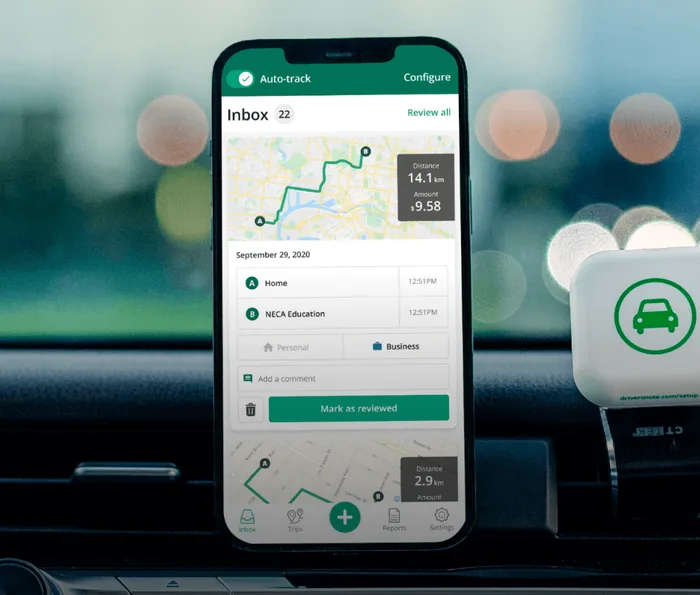
Tired of logging mileage by hand?
Effortless. IRS-compliant. Liberating.
 Auto-track trips
 Classify trips
 IRS compliant reports