Latest update: 2 June 2026 - 10 min read
Claiming your phone on tax in Australia
If you use your phone for work, you can claim part of what it costs you back on tax. The catch: you can only claim the business-related share, you need to back it up with records, and you can’t double up on a deduction your employer (or another tax method) already covers.
That’s true whether you’re an employee using your personal mobile for the odd client call or a sole trader running your whole business from a smartphone.
The ATO has separate rules for mobile calls and data, home phone and internet, buying a new device, and running a business from home. Each has its own shortcuts, percentages, and traps.
This guide walks through all of them, using the current ATO rates, example calculations, and the differences between employees and self-employed people.
Who can claim phone expenses on tax?
Most people who pay for their own phone and use it for work can claim something. The amount and the method change depending on your situation.
Employees
If you’re an employee, you can claim work-related phone calls and mobile data that you pay for yourself. You can’t claim anything your employer reimburses you for, or where your employer pays the bill directly. Casual employees also can’t claim calls or texts to check shift availability, even when initiated by the employer.
Sole traders, freelancers, and contractors
If you’re self-employed, your phone is usually a business cost. You can claim the work-related share of your plan, the cost of a new handset, and a share of any home phone or internet you use for the business.
See our guide to sole trader deductions in Australia for the bigger picture.
The working from home fixed rate caveat
If you’re using the ATO’s 70 cents per hour fixed rate method for working from home tax deductions, your phone and data use are already included in that rate. You can’t claim a separate deduction for mobile or home phone calls and data on top of it. If you want to claim phone expenses separately, use the actual cost method for your work-from-home claim instead.
What you can’t claim
Regardless of your situation, the ATO won’t allow a deduction for:
- Personal calls, texts, and data, including calls to family or friends, and using data for streaming.
- Phone or device costs your employer reimburses or pays directly.
- Installation or set-up fees for a phone or internet service (these are capital costs).
- Calls or texts to or from an employer about shift availability if you’re a casual employee.
- Job-seeking calls, because you’re not earning assessable income from them.
How to claim mobile phone calls and data on tax
Once you’ve confirmed you’re eligible, the next step is working out the work-related share of your mobile costs. The ATO gives you two routes: a quick method for small claims, and a more detailed method for larger ones.
The incidental use shortcut ($50 or less)
If your total claim is $50 or less and you only use your phone for work now and then, you can skip the percentages and use the ATO’s flat rates:
- $0.75 for each work-related call from your mobile.
- $0.10 for each work-related text message from your mobile.
You still need a basic record showing how you got to the total. A short log of calls and texts is enough. For example, 20 work calls and 30 work texts in a month works out to (20 × $0.75) + (30 × $0.10) = $18.
Working out your business-use percentage ($50 or more, regular business use)
If your claim is more than $50, or you use your phone for work regularly, you’ll need to work out a fair business-use percentage and apply it to your bills for the year. The ATO accepts a continuous four-week period as a representative sample, which you can then use across the whole income year.
How you split the use depends on whether your bill is itemised:
- Itemised bills: count work calls and data against your totals. For example, the number of work calls as a percentage of all calls, or work data downloaded as a percentage of total data.
- Non-itemised or prepaid plans: keep a four-week log of calls made and time spent on work data, and use that as your sample.
Example: Itemised bill
| Julie has a $65 per month mobile plan with unlimited calls and 80GB of data. She uses one monthly bill to work out her percentage. Counting work calls and matching data use to client meetings in her calendar, she calculates that 20% of her phone use is work-related. She worked 11 months that income year, so her claim is: 20% × $65 × 11 = $143 deduction for the year. |
Can I claim the cost of buying a phone?
Yes, if you use it for work. How you claim depends on what the phone cost you. The ATO splits this into two brackets: $300 or less, and more than $300.
Phones costing $300 or less
If a phone (or any depreciating work device) cost $300 or less, you can claim an immediate deduction in the year you bought it, provided you use it more than 50% for work and the other ATO tests are met. You still apportion the claim by your work-use percentage, so a $250 phone used 70% for work gives you a deduction of $175.
Phones costing more than $300
Phones costing more than $300 are treated as a depreciating asset, so you claim the decline in value over the phone’s effective life. The ATO’s published effective life for a mobile phone is 3 years. You then choose between two depreciation methods.
- Prime cost: 33.33% of the cost each year for three years (a straight-line deduction).
- Diminishing value: 66.67% of the remaining value each year, giving a bigger deduction up front and less later.
Whichever method you pick, apply your work-use percentage on top. For more on how depreciation works across your other assets, see our guide to small business depreciation.
Example: phone over $300 with mixed use
| Sarah, a freelance designer, buys a $1,200 smartphone on 1 July and uses it 60% for business. Using the prime cost method (33.33% per year): $1,200 × 33.33% × 60% = $240 deduction in year one. She’d claim a similar amount in years two and three, until the phone is fully depreciated. If she chose the diminishing value method instead, her first-year claim would be larger ($1,200 × 66.67% × 60% = $480) and smaller in later years. |
How to claim home phone and internet
If you use a home phone or home internet for work, you can claim the work-related share of those costs too. The ATO’s home phone and internet rules mirror the mobile rules, with a few twists for bundled plans and shared households.
Home phone incidental rate
For small home phone claims, the incidental rate is $0.25 per work call. As with mobile, this only works if your total claim is $50 or less and you keep a basic log.
Working out work-related internet use
For larger claims, work out a reasonable percentage based on a continuous four-week record. The ATO will accept any of the following as the basis for your split:
- Work data as a percentage of the household’s total data use.
- Time spent online for work as a percentage of total household internet time.
- Any extra costs your work use caused, such as exceeding your plan’s data limit.
How do I claim a bundled phone and internet plan?
Bundled plans are common, and the ATO has a specific three-step approach for them:
Step 1: Identify the cost of each service in the bundle. Use the supplier’s breakdown if it’s on your bill, or use a comparable supplier’s prices if it isn’t.
Step 2: Work out your work-use percentage for each service separately (phone calls, data, pay TV).
Step 3: Multiply each service’s monthly cost by its work-use percentage, then by the number of months you worked.
Example
| Des has a $90 home phone and internet bundle with no clear breakdown. Other providers charge around $10 for a home phone bundled with internet, so he uses $10 for the phone and $80 for the internet. He keeps a four-week log and works out that 25% of his calls and 30% of his data are work-related. Over 11 months worked, his deduction is: Internet: 30% × $80 × 11 = $264 Home phone: 25% × $10 × 11 = $27.50 Total: $291.50 |
Claiming phone use as a home-based business expense
If you run your business from home as a sole trader, your phone can also be claimed under the ATO’s home-based business expense rules. You can’t claim the same costs twice, so you’ll choose one approach.
Also read: Working from Home Tax Deductions
Fixed rate method (70 cents per hour)
Under this method, you claim 70 cents for every hour you work from home for the 2025 to 2026 income year. That rate already covers electricity, gas, internet, mobile and home phone, plus stationery and computer consumables, so you can’t claim those again separately. You can still claim depreciation of your phone, computer, or office furniture on top.
To use it, keep a record of all hours worked from home for the full year, and one bill for each of the running expenses the rate covers.
Actual cost method
If a flat rate doesn’t suit you, the actual cost method lets you claim the specific business-use share of each expense. You add up phone calls, internet, electricity and so on, and apply a work-use percentage to each. It takes more record-keeping but can produce a bigger deduction if your home-based business use is heavy. You can also claim depreciation on equipment separately.
A note on companies and trusts
If your business is run through a company or trust rather than as a sole trader or partnership, the rules are different. The home isn’t an asset of the entity, and any reimbursement to you is treated more like a fringe benefit. See the ATO’s home-based business expenses guidance for the specifics, or check with your accountant.
What records do I need to keep?
Whichever method you use, the ATO expects you to be able to show how you got to your claim. For phone expenses that means:
- Your monthly bills, or basic records if you’re using the $50 or less shortcut.
- Receipts for any handset or device purchases.
- A diary or log covering at least a continuous four-week period that shows your work-use pattern.
- Calculations supporting any depreciation claim, including the method and effective life you used.
Keep these records for five years from the date you lodge your return. If you’ve ever wondered what the ATO accepts in lieu of paperwork, our guide on claiming on tax without receipts runs through your options.
Do you also drive for work?
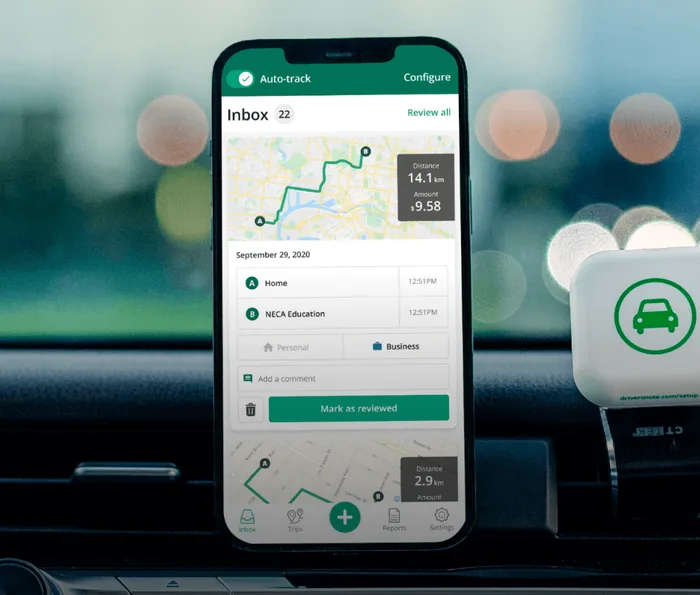
If you also drive for work, the same logic applies to your car: work out the business-use share and keep the records to back it up. Our self-employed deductions guide covers the other costs worth claiming, and Driversnote tracks your work trips automatically so the kilometre side of your return is one less thing to count.
FAQ
You can claim a total of up to $300 in work-related expenses (across all categories, not just phone) without full written evidence, as long as you can explain how you arrived at the amount. Above that, you need bills, receipts and a usage log. The $50-or-less incidental rate for mobile use is a separate shortcut that doesn't require itemised bills, just a basic record of work calls and texts.
Only if you use it exclusively for work, for example a dedicated business handset that never makes personal calls. Most people can't, and a high work-use percentage attracts ATO scrutiny, so you'll need a four-week log to back it up. If you also use the phone privately, you have to apportion the claim.
Yes. You can claim the work-related portion of any insurance you pay on the device, using the same business-use percentage you apply to the phone itself. So a phone used 40% for work means 40% of your insurance premium is deductible.
If your monthly plan rolls in the handset cost (sometimes called a device repayment), you claim the work-use share of the total monthly bill. If the contract itemises the handset separately, the device is treated as a depreciating asset and follows the rules for phones over $300, while the service portion of the bill is claimed monthly at your work-use percentage.
You can claim work calls and data on your personal phone if you genuinely use it for work, for example when the company phone isn't with you. You can't claim anything your employer pays for, reimburses you for, or supplies directly.
Yes. Accessories you use with a work phone are claimable at your work-use percentage. Items costing $300 or less can be claimed immediately; anything above that is depreciated over its effective life, the same as the phone itself.
The $0.75 per work call (plus $0.10 per text and $0.25 per home phone call) is a shortcut for small mobile and home phone claims of $50 or less. The 70 cents per hour fixed rate is a separate working-from-home method that bundles phone, internet, electricity, gas and consumables into a single hourly figure. You can use one or the other, but not both for the same costs.
You'll need your phone and internet bills for the year, a continuous four-week log showing your work-use pattern, receipts for any device purchases, and your depreciation calculations if you claimed decline in value. Keep these records for five years from the date you lodged the return.
Tired of logging mileage by hand?
Effortless. IRS-compliant. Liberating.
 Auto-track trips
 Classify trips
 IRS compliant reports